The Document in Your Hand Is Serious. Your Next 24 Hours Matter the Most.
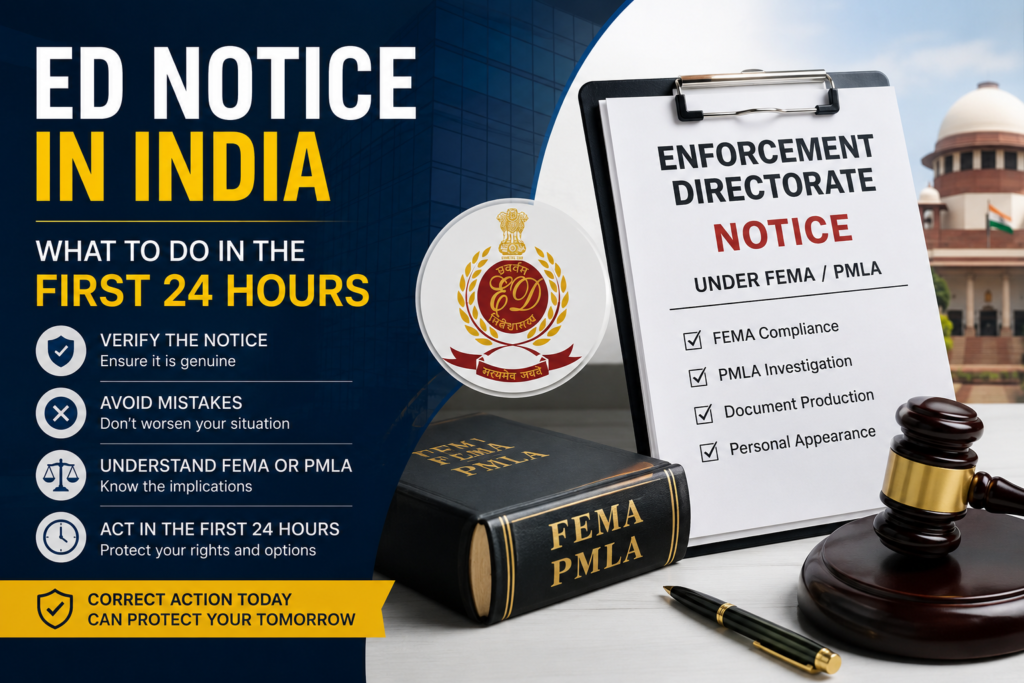
Receiving an Enforcement Directorate (ED) notice can be overwhelming. Your first instinct may be panic- but the actions you take in the first 24 hours can significantly influence the outcome of the investigation.
An ED notice is not a conviction. It is not a declaration of guilt. It is an official communication asking you to participate in an investigation. How you respond will determine what happens next.
At Femabide Advisorz, we help businesses, NRIs, exporters, importers, startups, and individuals across Hyderabad, Bengaluru, Andhra Pradesh, Telangana, Karnataka, Chennai, and other Indian cities respond to ED notices under FEMA and PMLA with a structured compliance strategy.
What Is an ED Notice?
The Enforcement Directorate issues notices under different laws. Understanding which law applies is the first step toward building the right response.
1. FEMA Notice (Section 37)
A FEMA notice generally asks you to appear before the Enforcement Directorate and produce documents relating to a suspected foreign exchange violation.
Since FEMA is a civil law, violations generally result in monetary penalties rather than imprisonment.
Possible consequences include:
- Penalty up to three times the amount involved
- Asset seizure under Section 37A
- Directions to regularize FEMA compliance
2. PMLA Summons (Section 50)
A summons under the Prevention of Money Laundering Act (PMLA) is considerably more serious.
Since PMLA is a criminal law, it may involve:
- Investigation into proceeds of crime
- Arrest
- Prosecution
- Imprisonment
- Asset attachment
Immediate professional guidance is recommended if you receive a PMLA summons.
3. FEMA Show Cause Notice
A Show Cause Notice generally means the investigation has already progressed and the ED believes a violation has occurred.
At this stage, the opportunity for voluntary compliance may already be narrowing.
4. Provisional Attachment Order
If your assets have been attached under PMLA, immediate legal and compliance action is necessary.
Do not delay your response.
Step 1: Verify That the ED Notice Is Genuine
Unfortunately, fake ED notices have become increasingly common.
The Enforcement Directorate has publicly warned citizens about forged summons being used for scams and extortion.
Verify your notice by:
- Visiting the official ED portal
- Clicking Verify Your Summons
- Entering the summons number
- Entering the unique passcode printed on the notice
A genuine summons generally contains:
- QR Code
- Unique Passcode
- Official reference number
Important Warning
There is no concept of “digital arrest” under Indian law.
No ED officer can arrest someone over:
- Zoom
- Google Meet
- Video Call
- Phone Call
Anyone claiming otherwise is committing fraud.
Step 2: Avoid These Costly Mistakes
Many ED investigations become more complicated because of avoidable mistakes.
Never:
- Contact the investigating officer informally
- Send documents without professional review
- Make unofficial payments to anyone claiming to “settle” the matter
- Ignore the summons
- Destroy or modify documents
- Attend the ED office without proper preparation
Every statement you make becomes part of the official investigation record.
Step 3: Contact a FEMA Compliance Specialist Immediately
Once you’ve verified the notice, seek advice from professionals who regularly handle FEMA and ED matters.
A specialist can help you understand:
- What the notice actually means
- Which transactions are under investigation
- Whether any FEMA violations exist
- Whether RBI compounding is still available
- What documents should be produced
At Femabide Advisorz, our rapid assessment helps clients understand their legal position before appearing before the Enforcement Directorate.
Step 4: Understand What the ED Is Investigating
Most FEMA investigations involve one or more of the following:
Export & Import Compliance
- Unrealised export proceeds
- Open EDPMS entries
- Unauthorized payment routes
- Third-party payments
NRI Compliance
- Resident bank accounts after becoming NRI
- Agricultural land purchases
- Property sale proceeds
- Foreign asset disclosures
Foreign Direct Investment (FDI)
- Delay in FC-GPR filing
- Sectoral approval issues
- Valuation non-compliance
- Incorrect reporting
Overseas Direct Investment (ODI)
- Overseas subsidiaries
- APR filing delays
- Restricted overseas investments
External Commercial Borrowings (ECB)
- Missing ECB registration
- Non-filing of ECB-2 returns
- End-use violations
Hawala & Unauthorized RemittancesCross-border transactions conducted outside authorised banking channels are closely scrutinized by the ED.
Step 5: Assess the RBI Compounding Window Immediately
This is often the most important step.
Under Section 15 of FEMA, eligible violations can be regularized through RBI’s Compounding Scheme.
If approved:
- The violation is regularized
- A one-time penalty is paid
- ED proceedings for that violation generally conclude
However, this opportunity is available only before adjudication is completed.
Waiting too long may permanently close this option.
Published RBI Compounding Examples
| Company | Amount Involved | Compounding Amount |
|---|---|---|
| Kakinada Seaports | ₹53 Crore | ₹21.68 Lakh |
| Genpact India | ₹13 Crore | ₹4.72 Lakh |
| Deccan Digital Networks | ₹23 Crore | ₹1.03 Lakh |
These published orders demonstrate why early action can significantly reduce financial exposure.
Step 6: Prepare Your Documents Properly
Before submitting documents:
- Review every document carefully
- Arrange documents chronologically
- Create an indexed document file
- Prepare explanations for each transaction
- Produce only documents requested in the notice
- Never alter, remove or destroy records
A properly organised submission demonstrates transparency and cooperation.
Step 7: Prepare for Your ED Appearance
Preparation is essential.
Before attending:
- Understand every questioned transaction
- Review your documents
- Prepare factual explanations
- Discuss possible questions with your advisor
- Carry all required records
During your appearance:
- Answer truthfully
- Keep answers precise
- Don’t guess
- Don’t volunteer unnecessary information
- Request a copy of your recorded statement whenever available
What Your First 24 Hours Should Look Like
| Timeline | Recommended Action |
|---|---|
| Hour 0–1 | Stay calm. Read the notice carefully. Take photographs of every page. |
| Hour 1–2 | Verify whether the notice is genuine. |
| Hour 2–4 | Consult a FEMA compliance specialist. |
| Hour 4–12 | Identify the transactions involved. |
| Hour 12–24 | Gather documents, assess RBI compounding eligibility, and prepare your response strategy. |
How Femabide Advisorz Can Help
Femabide Advisorz provides end-to-end FEMA advisory and ED notice assistance across India.
Our services include:
- ED Notice Review
- FEMA Compliance Assessment
- RBI Compounding Applications
- FEMA Representation
- Document Review
- ED Appearance Preparation
- FEMA Compliance Audit
- Import & Export FEMA Compliance
- FDI & ODI Advisory
- NRI FEMA Advisory
- ECB Compliance
Whether you’re an individual, startup, exporter, importer, NRI, or multinational company, our team helps you respond confidently and compliantly.
Frequently Asked Questions (FAQs)
1. Is receiving an ED notice the same as being arrested?
No. An ED notice is simply part of an investigation. Receiving a notice does not mean you are guilty or that arrest is imminent.
2. Can I ignore an ED summons?
No. Ignoring an ED summons may lead to further legal action and can adversely affect your case.
3. Can I attend the ED office alone?
You can, but it is advisable to seek guidance from a FEMA compliance professional beforehand to understand your rights and obligations.
4. What is the difference between FEMA and PMLA?
FEMA deals with civil foreign exchange violations and generally involves monetary penalties. PMLA deals with money laundering and may involve criminal prosecution, arrest, and imprisonment.
5. Can FEMA violations be settled?
Yes. Many FEMA violations may be resolved through RBI’s Compounding Scheme, provided the application is made before the adjudication process is completed.
6. How quickly should I respond after receiving an ED notice?
Immediately. The first 24 hours are critical for verifying the notice, understanding the allegations, gathering documents, and assessing your legal and compliance options.
7. What documents are commonly requested by the ED?
Depending on the investigation, the ED may request:
- Bank statements
- Foreign remittance records
- Import/export documents
- Company financial statements
- FEMA filings
- Agreements and invoices
- FDI or ODI documentation
8. Can NRIs also receive ED notices?
Yes. NRIs may receive ED notices related to foreign assets, property transactions, bank accounts, overseas investments, remittances, or FEMA compliance issues.
9. Is RBI compounding available after receiving an ED notice?
In many cases, yes—provided the matter is eligible and the adjudication process has not been completed. Early assessment is essential.
10. Why should I consult a FEMA specialist instead of only a CA or general lawyer?
ED investigations often involve a combination of FEMA regulations, RBI compliance, corporate law, and enforcement procedures. A FEMA specialist understands these regulatory frameworks and can help evaluate compounding options, documentation, and compliance strategy alongside legal representation.
Need Help Responding to an ED Notice?
Receiving an ED notice can be stressful, but responding correctly from the very beginning can make a significant difference.
Femabide Advisorz assists clients across Hyderabad, Bengaluru, Telangana, Andhra Pradesh, Karnataka, Chennai, and throughout India with:
- ED Notice Advisory
- FEMA Compliance
- RBI Compounding
- FDI & ODI Advisory
- ECB Compliance
- NRI FEMA Matters
- FEMA Audits
- Representation before the Enforcement Directorate
Don’t wait until the investigation progresses. The earlier you act, the more compliance options may be available.