Andhra Pradesh has emerged as one of India’s fastest-growing destinations for startups and businesses. From technology and pharmaceutical companies in Visakhapatnam to manufacturing, infrastructure, and logistics businesses in Vijayawada, Amaravati, Tirupati, Guntur, Kakinada, Nellore, and Sri City, companies across the state are increasingly raising foreign debt from overseas investors, parent companies, and international financial institutions.
For businesses considering international borrowing, understanding ECB for startups Andhra Pradesh foreign debt RBI rules is essential. Foreign borrowing is governed by the Foreign Exchange Management Act (FEMA), 1999 and the RBI’s ECB framework. Every eligible foreign loan must comply with RBI regulations, reporting requirements, and prescribed timelines.
FEMABIDE Advisorz is a specialist ECB consulting firm based in Hyderabad, providing end-to-end ECB compliance and FEMA advisory services for startups and businesses across Andhra Pradesh, including Visakhapatnam, Vijayawada, Amaravati, Tirupati, Guntur, Kakinada, Nellore, and Bengaluru.
What Is an External Commercial Borrowing (ECB)?
An External Commercial Borrowing (ECB) is any borrowing by an eligible Indian entity from a recognised non-resident lender.
Under the latest RBI framework, ECB generally falls into three categories:
- Foreign Currency ECB denominated in USD, EUR, GBP, JPY, CHF, SGD, AUD or CAD.
- INR ECB denominated in Indian Rupees from eligible overseas lenders, including IFSC branches of Indian banks.
- Trade Credit covering buyer’s credit and supplier’s credit for imports of goods and services.
Whether your startup receives a shareholder loan, bridge financing from an overseas investment fund, or debt from an international angel investor, the borrowing is generally treated as an ECB under FEMA and must comply with RBI regulations.
Who Can Borrow Under the ECB Framework?
The revised RBI framework has significantly expanded the category of eligible borrowers.
Eligible borrowers include:
- Private Limited Companies
- Public Limited Companies
- Startups
- Limited Liability Partnerships (LLPs)
- Partnership Firms
- Societies
- Co-operative Societies
- Companies undergoing restructuring or CIRP, subject to applicable conditions
For businesses across Andhra Pradesh, this means that most registered entities can access foreign borrowing, provided they satisfy RBI eligibility requirements.
Who Can Lend Under the ECB Framework?
Eligible lenders include:
- Foreign equity shareholders
- Overseas group companies
- International financial institutions
- Foreign individuals
- Offshore branches of Indian banks
- IFSC Banking Units
- Regional development banks
The updated framework has simplified lender eligibility, making it easier for Andhra Pradesh startups to access foreign debt from overseas investors.
Permitted End Uses of ECB
ECB funds may generally be used for:
- Capital expenditure
- Business expansion
- Eligible working capital requirements
- Refinancing existing ECBs
- Acquisition financing for obtaining management control, subject to RBI conditions
- Other permitted business purposes under the ECB framework
ECB proceeds may also be temporarily parked in permitted liquid investments until utilisation.
Prohibited Uses Under the ECB Negative List
ECB funds cannot be used for certain restricted purposes.
These include:
- Investment in Indian capital markets (except permitted strategic acquisitions)
- Real estate activities not covered under permitted infrastructure or township development
- On-lending for prohibited purposes
- Repayment of domestic rupee loans used for restricted activities
- Other prohibited end uses notified by RBI
Using ECB funds for prohibited purposes may result in FEMA contraventions and regulatory action.
ECB Maturity Requirements Under RBI Rules
The Minimum Average Maturity Period (MAMP) remains one of the most important ECB requirements.
Under the current RBI framework:
- General ECBs generally require a minimum maturity of three years.
- Manufacturing sector borrowers may qualify for shorter maturity periods, subject to RBI conditions.
- Maturity requirements should always be verified before finalising the loan agreement.
Structuring maturity correctly at the beginning helps businesses avoid future FEMA compliance issues.
Interest Rate and Pricing
The RBI has moved towards a market-based pricing approach for ECBs.
Instead of LIBOR, borrowers are expected to use Alternative Reference Rates (ARRs), including:
- SOFR for USD borrowings
- SONIA for GBP borrowings
- Other applicable benchmark rates depending on the borrowing currency
Proper pricing documentation is an important part of ECB compliance.
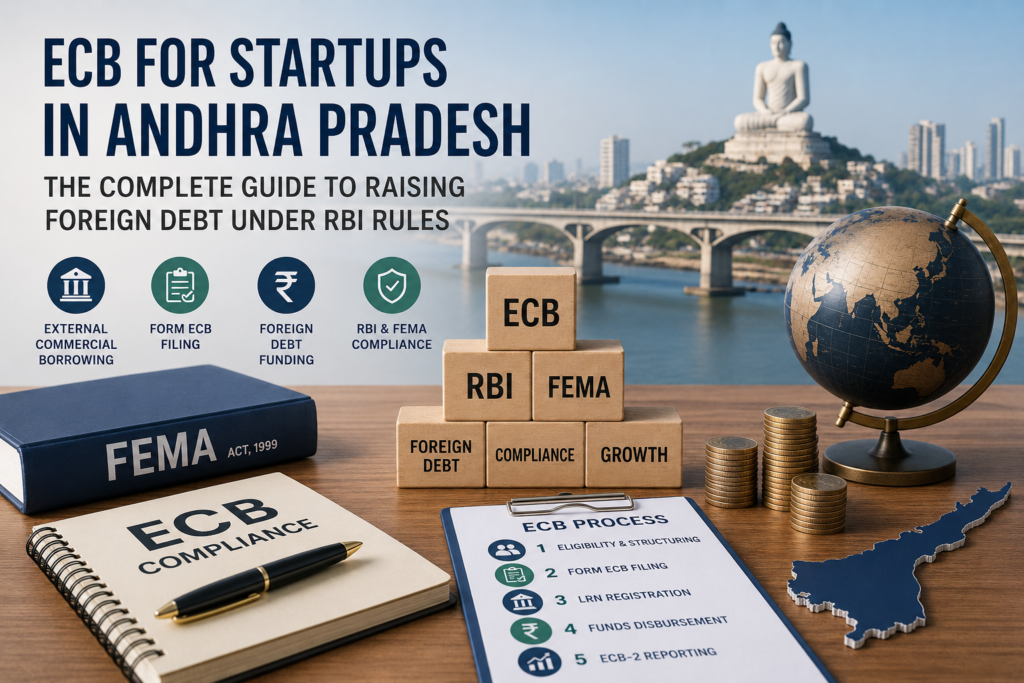
Form ECB Filing Process
Step 1: Prepare the Loan Agreement
Before receiving any foreign loan, the loan agreement should clearly specify:
- Borrower details
- Lender eligibility
- Loan amount
- Currency
- Interest rate
- Benchmark rate
- Maturity period
- Permitted end use
- Security, if applicable
Step 2: File Form ECB Through the AD Bank
Form ECB must be filed through the company’s Authorised Dealer (AD) Bank before receiving any loan proceeds.
The AD Bank reviews the application and forwards it to the RBI.
Upon approval, the RBI issues a Loan Registration Number (LRN).
Without an LRN, no ECB funds should be received.
Step 3: Receive the Loan
After obtaining the Loan Registration Number, the company may draw down the approved loan.
The funds should be utilised only for the declared and permitted end use.
Step 4: ECB-2 Reporting
Under the revised RBI framework, ECB-2 reporting is event-based rather than monthly.
ECB-2 must be filed through the AD Bank whenever there is:
- Utilisation of ECB proceeds
- Interest payment
- Principal repayment
- Prepayment
- Any other reportable ECB transaction
Failure to submit ECB-2 within the prescribed timeline may attract Late Submission Fees (LSF) and constitute a FEMA reporting default.
Common ECB Compliance Mistakes
Businesses frequently make the following mistakes:
- Receiving foreign loan proceeds before obtaining the Loan Registration Number.
- Incorrectly drafting loan agreements.
- Using ECB funds for prohibited purposes.
- Missing ECB-2 reporting deadlines.
- Incorrect maturity structuring.
- Assuming shareholder loans are exempt from FEMA regulations.
Working with an experienced ECB consultant helps businesses avoid these common compliance issues.
How FEMABIDE Advisorz Helps Andhra Pradesh Businesses
FEMABIDE Advisorz is a specialist FEMA and ECB consulting firm serving startups and businesses across Andhra Pradesh, including Visakhapatnam, Vijayawada, Amaravati, Tirupati, Guntur, Kakinada, Nellore, Kurnool, and Sri City.
Our services include:
- ECB Structuring Advisory
- Form ECB Filing
- Loan Registration Number (LRN) Assistance
- ECB-2 Reporting
- Conversion of ECB into Equity
- FC-GPR Filing
- FEMA Compliance Reviews
- RBI Compounding Applications
- FEMA Advisory for Startups and Businesses
Our team works closely with companies and Authorised Dealer Banks to ensure every stage of ECB compliance is completed accurately and within RBI timelines.
Frequently Asked Questions (FAQs)
1. What is an External Commercial Borrowing (ECB)?
An External Commercial Borrowing (ECB) is a loan raised by an eligible Indian company or entity from a recognised non-resident lender under RBI regulations.
2. Can startups in Andhra Pradesh raise foreign debt through ECB?
Yes. Eligible startups and companies in Andhra Pradesh can raise foreign debt through the ECB route, subject to RBI eligibility conditions and FEMA compliance requirements.
3. Is Form ECB mandatory?
Yes. Form ECB must generally be filed through the Authorised Dealer (AD) Bank before receiving any foreign loan under the ECB framework.
4. What is a Loan Registration Number (LRN)?
The Loan Registration Number (LRN) is issued by the RBI after successful Form ECB filing. Foreign loan proceeds should not be received before obtaining the LRN.
5. Who can lend money under the ECB framework?
Eligible lenders include foreign shareholders, overseas group companies, international financial institutions, foreign individuals, offshore branches of Indian banks, and IFSC Banking Units.
6. What is the minimum maturity period for ECB?
Most general ECBs require a minimum average maturity period of three years, while certain sectors may qualify for different maturity requirements under RBI regulations.
7. What is ECB-2 reporting?
ECB-2 is an event-based reporting requirement that must be filed whenever there is utilisation of ECB funds, repayment of principal, payment of interest, prepayment, or other reportable ECB transactions.
8. Can shareholder loans be treated as ECB?
Yes. Loans received from foreign shareholders are generally covered under the ECB framework and must comply with FEMA and RBI regulations.
9. What happens if ECB compliance requirements are missed?
Non-compliance may lead to FEMA contraventions, Late Submission Fees (LSF), RBI compounding proceedings, and regulatory scrutiny.
10. How can FEMABIDE Advisorz help?
FEMABIDE Advisorz provides end-to-end ECB advisory services, including ECB structuring, Form ECB filing, Loan Registration Number assistance, ECB-2 reporting, conversion-to-equity compliance, RBI compounding, and complete FEMA advisory for businesses across Andhra Pradesh.
Conclusion
Foreign borrowing can be an effective way for businesses to raise capital, but it also comes with strict RBI reporting and FEMA compliance obligations. Understanding ECB for startups Andhra Pradesh foreign debt RBI rules helps businesses structure overseas borrowing correctly, avoid regulatory violations, and ensure smooth compliance throughout the loan lifecycle.
Whether you are raising your first shareholder loan or securing international debt financing, FEMABIDE Advisorz provides comprehensive ECB compliance support to help your business meet every RBI requirement confidently.
Book an ECB compliance consultation today.