The ED FEMA enforcement 2026 export business landscape is changing rapidly. Indian exporters can no longer treat FEMA compliance as a back-office activity handled only during audits. It has become a core business risk that directly impacts international trade, foreign investments, overseas borrowing, and cross-border payments.
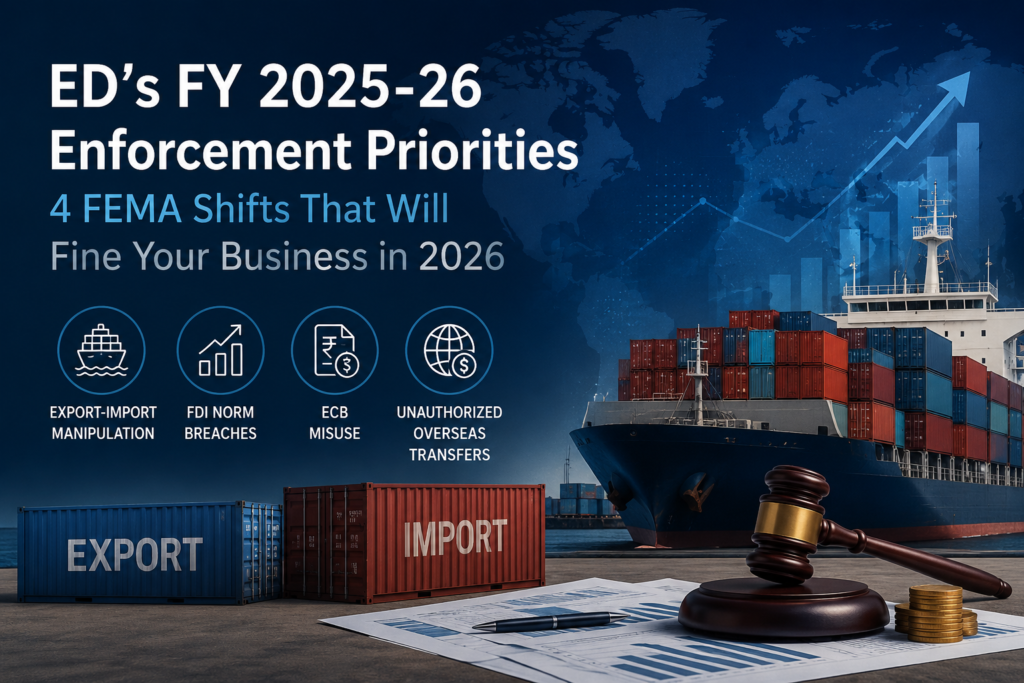
The Enforcement Directorate (ED), while releasing its FY 2025-26 Annual Report during its 70th year, highlighted the direction in which FEMA enforcement is moving. Although the report does not officially publish a checklist titled “FEMA Enforcement Priorities,” recent investigations, RBI compounding trends, enforcement statistics, and public enforcement actions clearly indicate four major compliance areas receiving increased scrutiny.
For businesses involved in exports, imports, foreign direct investment (FDI), External Commercial Borrowings (ECB), or overseas fund transfers, these emerging enforcement priorities deserve immediate attention.
At Femabide Advisorz, we have analysed the latest enforcement trends, studied recent ED cases, and reviewed RBI compliance patterns to explain what these changes mean for exporters in practical terms.
Why Every Export Business Should Pay Attention in 2026
The Enforcement Directorate is no longer focusing only on large-scale money laundering investigations. FEMA compliance has evolved into a separate enforcement priority.
Today, investigations increasingly begin with:
- Export proceeds not realized within prescribed timelines
- Improper third-party payments
- Delayed FEMA reporting
- Incorrect FDI filings
- ECB reporting failures
- Overseas remittances lacking supporting documentation
Many businesses discover these issues only after receiving notices from banks, RBI, or the Enforcement Directorate.
The objective should no longer be responding to enforcement. It should be preventing it through regular FEMA compliance reviews.
Shift 1: Export-Import Manipulation Has Become a Primary FEMA Enforcement Priority
The biggest change visible under the ED FEMA enforcement 2026 export business framework is the treatment of export-import manipulation as an independent enforcement category.
Previously, export documentation issues often surfaced only during broader hawala or money laundering investigations.
Today, export compliance itself is under direct scrutiny.
Authorities are closely examining:
- Export proceeds realization
- EDPMS closures
- Third-party payment arrangements
- Under or over-invoicing
- Trade mispricing
- Export documentation consistency
- Banking channels used for receiving payments
The authenticity of goods alone is no longer enough.
The payment route, contractual documentation, and FEMA reporting now carry equal importance.
The Opal Engineering Case
A recent investigation involving Opal Engineering illustrates this approach.
The company exported engineering products to countries including Syria, Iran, Turkey and Colombia.
The exports themselves were genuine.
However:
- Export proceeds were received through unrelated third parties.
- Funds entered personal accounts.
- No documented tripartite agreements existed.
- Cash settlements occurred in India and overseas.
The Enforcement Directorate conducted searches, seized approximately ₹22 lakh in cash, and investigations continue.
Key Learning for Exporters
Receiving payment through an unauthorized party can trigger FEMA investigations even if the underlying export transaction is genuine.
Before goods leave India:
- Ensure export contracts clearly identify the payer.
- Execute tripartite agreements where required.
- Inform the Authorised Dealer (AD) Bank.
- Maintain complete documentary evidence.
Shift 2: FDI Compliance Is Being Examined Alongside Export Compliance
Foreign Direct Investment compliance is now receiving much deeper examination.
Businesses often assume export compliance and FDI compliance are separate processes.
Increasingly, they are being reviewed together.
During export-related inspections, authorities are also checking:
- FC-GPR filings
- Share valuation reports
- Sectoral compliance
- Pricing guidelines
- Downstream investment reporting
- Business activity declarations
- FEMA reporting timelines
Late or incorrect reporting may now surface during unrelated export reviews.
The Newsclick Matter
One widely discussed FEMA case involved alleged:
- Misrepresentation of business activities
- Incorrect FDI reporting
- Service export classification issues
- Failure to complete SOFTEX compliance
Substantial FEMA penalties were imposed on both the company and its management.
Whether or not a business believes its reporting errors were procedural, enforcement demonstrates that FEMA documentation is now treated very seriously.
What Export Businesses Should Review
If your company has foreign investors:
- Review all FC-GPR filings.
- Verify RBI reporting timelines.
- Check valuation documentation.
- Confirm sectoral eligibility.
- Ensure FEMA records match MCA filings.
A combined export and FDI compliance audit has become far more valuable than reviewing these areas separately.
Shift 3: ECB Misuse Is Moving Beyond RBI Compounding
External Commercial Borrowings have traditionally been regulated through RBI reporting and compounding.
The recent enforcement direction suggests a shift toward investigation-based discovery.
Businesses should not assume that reporting gaps will only result in administrative penalties.
Authorities are increasingly reviewing:
- Form ECB filings
- ECB-2 monthly reporting
- End-use compliance
- Loan utilization
- Drawdown timelines
- Permitted borrowing structures
Export-oriented companies frequently use ECB funding for:
- Capacity expansion
- Infrastructure
- Manufacturing
- Technology upgrades
- Working capital
Improper utilization or reporting can now attract significantly greater attention.
Recommended Compliance Review
Businesses should verify:
- Form ECB filed before first drawdown
- ECB registration completed
- Monthly ECB-2 returns filed
- End-use conditions followed
- Loan documentation properly maintained
Shift 4: Unauthorized Overseas Fund Transfers Now Include Indirect Structures
Perhaps the most significant change under the ED FEMA enforcement 2026 export business environment is the broader interpretation of unauthorized overseas fund transfers.
Earlier, investigations largely focused on direct hawala transactions.
Today, authorities are also examining:
- Layered fund transfers
- Shell entities
- Related-party routing
- Undisclosed payment structures
- Circular transactions
- Third-party overseas settlements
Why Section 37A Matters
Recent FEMA enforcement has increasingly relied upon Section 37A, which empowers authorities to freeze assets where foreign exchange is believed to have been held outside India in violation of FEMA.
This significantly raises the compliance stakes for businesses handling international payments.
Practical Risk for Exporters
Many exporters encounter situations where overseas buyers request:
- Payment through a holding company
- Payment from an affiliate
- Settlement through relatives
- Payment via another group entity
Although commercially common, these arrangements require proper FEMA documentation.
Without prior disclosure and supporting agreements, authorities may question the legitimacy of the payment route.
What Every Export Business Should Do Before the Next Shipment
The latest ED annual report FEMA priorities make one thing clear: prevention is far less expensive than enforcement.
Before your next shipment, ensure that:
Review Export Documentation
Every export invoice, shipping document and contract should identify the correct buyer and payment structure.
Validate Third-Party Payments
If someone other than the overseas buyer will make payment, execute documented tripartite agreements before shipment and notify your AD Bank.
Monitor EDPMS
Open EDPMS entries should never remain pending beyond prescribed timelines.
Delayed export realization is increasingly viewed as an enforcement signal.
Review FDI Compliance
Confirm:
- FC-GPR submissions
- Valuation reports
- FEMA reporting
- Pricing compliance
Review ECB Compliance
Check:
- Form ECB
- ECB-2 reporting
- End-use documentation
- Loan utilization
Consider FEMA Compounding
If historical violations already exist, voluntary compounding under Section 15 of FEMA is generally more economical than waiting for investigation.
Early disclosure often results in significantly lower penalties compared to contested enforcement proceedings.
Why FEMA Compliance Audits Matter More Than Ever
Modern FEMA investigations increasingly combine multiple compliance streams.
One review may simultaneously examine:
- Export proceeds realization
- FDI reporting
- Overseas remittances
- ECB utilization
- Banking documentation
- Board approvals
- RBI filings
Businesses that maintain organised records are better positioned to respond quickly to regulatory scrutiny.
Regular FEMA compliance audits also help identify reporting gaps before they become enforcement issues.
How Femabide Advisorz Helps Export Businesses
At Femabide Advisorz, we help exporters proactively manage FEMA compliance before regulatory issues arise.
Our FEMA compliance reviews include:
- Export proceeds realization audit
- EDPMS reconciliation
- Third-party payment compliance
- FEMA documentation review
- FDI reporting verification
- FC-GPR compliance
- ECB filing review
- ECB end-use verification
- Overseas remittance compliance
- FEMA compounding advisory
- RBI compliance support
- Section 37A risk assessment
Rather than reacting to notices, businesses can identify and correct compliance gaps before they escalate.
If your export business has not completed a comprehensive FEMA compliance review during the last twelve months, now is the right time to act.
Frequently Asked Questions (FAQs)
1. What are the ED FEMA enforcement priorities for 2026?
The major enforcement focus areas include export-import manipulation, FDI compliance breaches, misuse of External Commercial Borrowings (ECB), and unauthorized overseas fund transfers. These trends are reflected in recent ED investigations and RBI enforcement activity.
2. Why is export proceeds realization becoming more important?
Delayed or improperly documented export proceeds are increasingly treated as indicators of potential FEMA violations. Businesses should closely monitor EDPMS and ensure timely realization through authorized banking channels.
3. Can third-party payments trigger FEMA action?
Yes. Third-party payments are permitted only when supported by proper documentation, including tripartite agreements and disclosure to the Authorised Dealer Bank. Poor documentation can attract regulatory scrutiny.
4. How does FDI compliance affect exporters?
Export businesses that have received foreign investment should ensure FC-GPR filings, valuation reports, pricing guidelines, and FEMA reporting are fully compliant, as these are increasingly reviewed during export-related investigations.
5. What happens if ECB reporting is delayed?
Failure to file Form ECB, ECB-2 returns, or comply with permitted end-use conditions may result in regulatory action, compounding proceedings, or investigations depending on the nature of the violation.
6. What is Section 37A under FEMA?
Section 37A empowers authorities to seize or freeze assets where foreign exchange is suspected to have been held outside India in contravention of FEMA provisions.
7. Can historical FEMA violations still be corrected?
Yes. Many historical FEMA violations can be resolved through the RBI’s compounding mechanism, provided businesses voluntarily disclose and rectify non-compliance before enforcement action progresses.
8. How often should exporters conduct a FEMA compliance audit?
Businesses engaged in regular international trade should ideally conduct a comprehensive FEMA compliance audit annually or whenever there are significant changes involving exports, FDI, ECB, or overseas remittances.
Conclusion
The ED FEMA enforcement 2026 export business environment marks a clear shift from reactive enforcement to proactive scrutiny. Exporters are expected to maintain complete compliance across export documentation, foreign investment reporting, overseas borrowing, and cross-border payment structures.
Waiting for a notice is no longer a practical compliance strategy. Businesses that conduct periodic FEMA audits, maintain accurate documentation, and address reporting gaps early are significantly better positioned to avoid penalties, investigations, and operational disruptions.
At Femabide Advisorz, we help export businesses navigate complex FEMA regulations with practical compliance reviews, documentation support, RBI advisory, and compounding assistance so that international growth is backed by regulatory confidence rather than compliance risk.