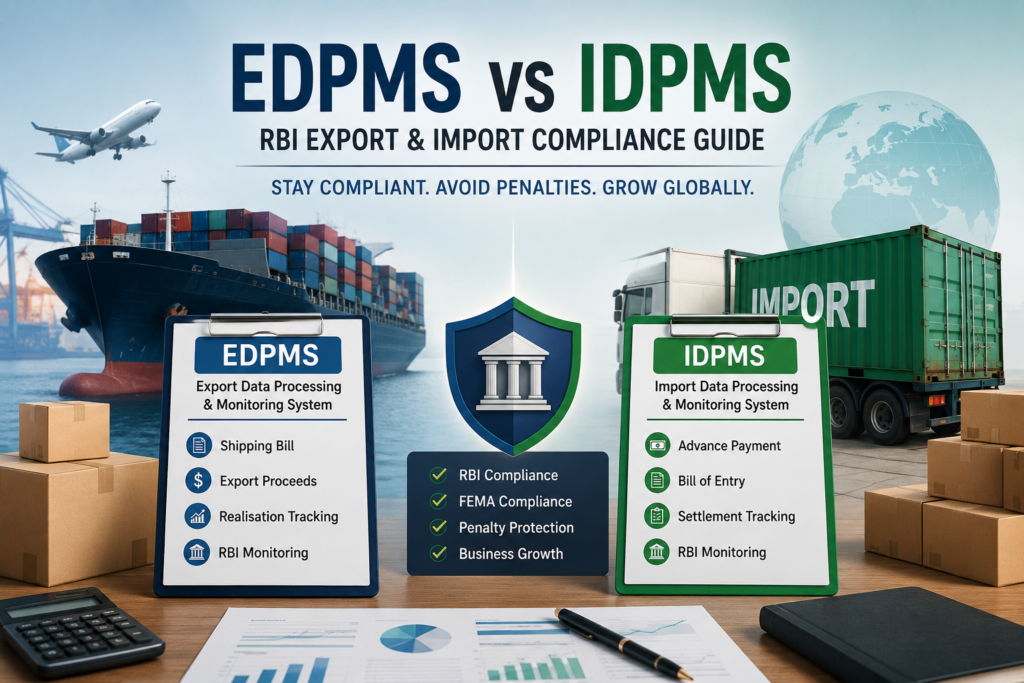
EDPMS vs IDPMS: Why Hyderabad Businesses Must Pay Attention
Hyderabad has become one of India’s leading export and import hubs. Pharmaceutical companies, IT service providers, engineering manufacturers, textile exporters, and trading businesses handle thousands of international transactions every year. Every export shipment and import payment is monitored by the Reserve Bank of India through two important systems, EDPMS and IDPMS.
Understanding EDPMS vs IDPMS is essential for every business involved in international trade. These RBI monitoring systems track export proceeds, import payments, and transaction settlements. If entries remain unresolved, businesses may face FEMA penalties, regulatory notices, or increased scrutiny from the Enforcement Directorate (ED).
At Femabide Advisorz, we help Hyderabad exporters and importers understand their compliance obligations, resolve outstanding entries, and reduce regulatory risks. This guide explains everything you need to know about EDPMS vs IDPMS, common compliance issues, and the steps businesses should take to stay compliant.
What is EDPMS?
EDPMS, or Export Data Processing and Monitoring System, is an RBI-managed online platform that monitors export transactions from India.
Whenever an exporter files a shipping bill with Customs, an entry is automatically created in EDPMS. This entry remains open until the Authorised Dealer (AD) Bank confirms that the export proceeds have been received through an approved banking channel and matched with the corresponding shipping bill.
If export proceeds are not realized within the prescribed RBI timeline or the payment cannot be matched, the EDPMS entry remains unresolved. Such unresolved entries may lead to FEMA compliance issues and regulatory follow-up.
EDPMS replaced the earlier manual reporting process, allowing RBI and AD Banks to monitor export transactions in real time.
What is IDPMS?
IDPMS, or Import Data Processing and Monitoring System, is RBI’s online monitoring platform for import transactions.
Whenever an importer sends advance payment to an overseas supplier, an IDPMS entry is automatically created. The entry remains open until the importer submits the corresponding Bill of Entry, receives a valid extension, obtains an approved write-off, or receives a refund of the advance payment.
If imported goods do not arrive or the transaction is not properly documented, the IDPMS entry remains outstanding. This creates a potential FEMA compliance issue and may attract regulatory attention.
Like EDPMS, IDPMS enables RBI and AD Banks to monitor import transactions electronically and identify unresolved cases quickly.
EDPMS vs IDPMS: Key Differences
Although both systems are managed by RBI, they serve different purposes.
| Particulars | EDPMS | IDPMS |
|---|---|---|
| Full Form | Export Data Processing and Monitoring System | Import Data Processing and Monitoring System |
| Applicable To | Exporters | Importers |
| Trigger | Shipping Bill | Advance Import Payment |
| Tracks | Export Proceeds | Import Payment Settlement |
| Closed By | Receipt of Export Proceeds | Bill of Entry, Refund, Extension or Write-off |
| Purpose | Monitor Export Compliance | Monitor Import Compliance |
Understanding EDPMS vs IDPMS helps businesses manage both export and import transactions efficiently while avoiding compliance risks.
How RBI Monitors Export and Import Transactions
RBI has significantly strengthened its monitoring framework through automation and digital reporting.
Every export and import transaction reported by Customs and Authorised Dealer Banks is automatically reflected in EDPMS or IDPMS. If entries remain open beyond the prescribed period, the system generates alerts for the concerned AD Bank.
Banks are expected to contact exporters or importers, seek supporting documents, and ensure timely closure of pending entries. Long-pending transactions may be reported to RBI for further action.
This automated monitoring has reduced manual intervention and increased the likelihood of unresolved cases being identified.
What is XOS Reporting?
The Export Outstanding Statement (XOS) is prepared by Authorised Dealer Banks using information available in EDPMS.
It contains details of export shipments where proceeds have not been realized within the prescribed period.
RBI uses XOS reports to monitor delayed export realizations and identify businesses with outstanding export receivables.
If your company appears repeatedly in XOS reports, your AD Bank may seek explanations or additional documents, and prolonged delays may increase regulatory scrutiny.
Common EDPMS Compliance Mistakes
Many exporters unknowingly create compliance issues that leave entries open in EDPMS.
Receiving Export Payments Outside Banking Channels
Export proceeds must be received through approved banking channels. Cash settlements or informal payment methods cannot be recognized for EDPMS closure.
Third-Party Payments Without Proper Documentation
If a payment is received from someone other than the overseas buyer, supporting documentation and RBI guidelines must be followed. Otherwise, the AD Bank may refuse to close the EDPMS entry.
Payment Received in a Personal Bank Account
Export proceeds should be credited to the company’s authorised account maintained with the AD Bank. Personal account receipts often create reconciliation issues.
Delay in Export Realization
Failure to realize export proceeds within the RBI-prescribed timeline may require an extension or further regulatory approval.
Incorrect Shipping Bill Matching
Sometimes payment reaches the bank, but incorrect shipping bill details prevent automatic matching, leaving the EDPMS entry open.
Common IDPMS Compliance Mistakes
Importers also face several compliance issues that can leave transactions unresolved.
Advance Payment Without Import
Import advances sent overseas must eventually be matched with a Bill of Entry, refund, or approved write-off.
Delay in Filing the Bill of Entry
Late filing of import documentation may prevent automatic settlement of the IDPMS entry.
Missing Supporting Documents
Incomplete import documentation often delays reconciliation between the bank and Customs records.
Import Cancellation Without Refund
If imported goods are cancelled but the advance payment is not refunded or regularized, the IDPMS entry remains outstanding.
Improper Related Party Transactions
Cross-border transactions with overseas group companies should follow RBI guidelines and proper banking procedures.
FEMA Penalties for Open EDPMS and IDPMS Entries
Ignoring unresolved EDPMS or IDPMS entries can become expensive. Under the Foreign Exchange Management Act (FEMA), businesses may face financial penalties and increased regulatory scrutiny for non-compliance.
Continuing Penalty
If a FEMA violation continues after it is identified, a continuing penalty of up to ₹5,000 per day may apply until the non-compliance is resolved, where permitted under the applicable legal provisions.
Principal Penalty
Under Section 13 of FEMA, the authorities may impose a penalty of up to three times the amount involved in the contravention where the amount is quantifiable, or as otherwise provided under the Act.
Regulatory Scrutiny
Long-pending export or import transactions may attract additional scrutiny from RBI, your Authorised Dealer Bank, or other enforcement authorities. Delays in resolving outstanding entries can also affect future cross-border transactions and banking relationships.
The earlier a compliance issue is addressed, the easier it is to resolve.
How to Check Your EDPMS and IDPMS Status
Every exporter and importer should periodically review their compliance status.
Contact your Authorised Dealer (AD) Bank and request a detailed report of your outstanding transactions.
Ask for:
- Complete EDPMS report
- Open shipping bills
- Export Outstanding Statement (XOS) details
- Complete IDPMS report
- Unmatched import advance payments
- Pending Bills of Entry
- Transactions requiring clarification
Reviewing these reports regularly helps identify issues before they become major compliance concerns.
How to Close an Open EDPMS Entry
The resolution process depends on the reason the entry remains open.
Payment Received but Not Matched
Submit supporting documents such as:
- FIRC
- Bank Credit Advice
- Shipping Bill details
- Invoice
- Bank realization documents
The AD Bank can verify the documents and update the EDPMS record.
Export Proceeds Not Received
If payment has not been received, exporters may need to:
- Apply for an extension through the AD Bank
- Seek RBI approval where applicable
- Apply for write-off in eligible cases
- Explore FEMA compounding if a violation has already occurred
Third-Party Payment Cases
Provide complete documentation supporting the third-party payment, including agreements, invoices and any documents required by RBI guidelines. The AD Bank will review the transaction before considering closure.
How to Close an Open IDPMS Entry
Importers should act promptly when import transactions remain unresolved.
Possible solutions include:
- Submit the Bill of Entry to the AD Bank.
- Obtain a refund if goods are not supplied.
- Apply for an extension where permitted.
- Seek an approved write-off where eligible.
- Regularize historical transactions through the appropriate FEMA process if required.
Maintaining complete documentation significantly reduces delays.
Best Practices to Stay Compliant
Businesses engaged in international trade should establish strong compliance practices.
- Track every export shipment and import payment.
- Monitor EDPMS and IDPMS reports regularly.
- Maintain complete shipping and banking records.
- File Bills of Entry on time.
- Realize export proceeds within RBI timelines.
- Inform the AD Bank immediately about transaction changes.
- Document third-party payments properly.
- Conduct periodic FEMA compliance reviews.
Proactive compliance helps avoid penalties and improves banking relationships.
How Femabide Advisorz Helps
Femabide Advisorz assists exporters, importers and businesses across Hyderabad with RBI and FEMA compliance.
Our services include:
- EDPMS compliance review
- IDPMS reconciliation
- Export Outstanding Statement (XOS) review
- FEMA advisory
- RBI compliance consulting
- Documentation support
- AD Bank coordination
- FEMA compounding applications
- Import and export transaction advisory
- Regulatory notice assistance
Our team works closely with businesses to identify unresolved entries and develop practical compliance solutions.
Frequently Asked Questions
1. What is the difference between EDPMS and IDPMS?
EDPMS monitors export transactions and export proceeds, while IDPMS monitors import transactions and advance import payments. Understanding EDPMS vs IDPMS helps businesses comply with RBI and FEMA requirements.
2. Who is required to comply with EDPMS and IDPMS?
Every Indian exporter and importer conducting cross-border trade through Authorised Dealer Banks is required to comply with the applicable RBI reporting and documentation requirements.
3. What happens if an EDPMS entry remains open?
An unresolved EDPMS entry may lead to follow-up by the AD Bank, RBI scrutiny and possible FEMA action depending on the facts of the case.
4. Can third-party export payments be accepted?
Yes, subject to RBI guidelines and proper documentation. Businesses should consult their AD Bank before accepting such payments.
5. How can I check my EDPMS or IDPMS status?
You can request a detailed report from your Authorised Dealer Bank showing outstanding export and import transactions.
6. Can old EDPMS or IDPMS entries be regularized?
Many cases can be resolved through documentation, reconciliation, RBI approvals or compounding, depending on the nature of the transaction and applicable regulations.
7. Why is understanding EDPMS vs IDPMS important?
Understanding EDPMS vs IDPMS helps businesses avoid delays in export and import settlements, reduce compliance risks and maintain smooth international trade operations.
Conclusion
Understanding EDPMS vs IDPMS is no longer optional for businesses involved in international trade. RBI’s digital monitoring systems have made export and import compliance more transparent, making it essential for businesses to review outstanding transactions regularly.
Whether you are an exporter waiting for export proceeds or an importer managing advance payments, timely reconciliation and proper documentation can help prevent compliance issues and regulatory complications.
If your business has unresolved EDPMS or IDPMS entries, addressing them early is the best way to reduce risk and maintain smooth banking operations.
Need Expert Help with EDPMS and IDPMS Compliance?
Femabide Advisorz helps exporters and importers across Hyderabad manage FEMA compliance with confidence.
Our experts can help you:
- Review EDPMS and IDPMS records
- Resolve outstanding entries
- Coordinate with Authorised Dealer Banks
- Prepare FEMA documentation
- Handle RBI compliance matters
- Assist with compounding applications where required
Call us today: +91 99333 85556
Visit www.femabide.com to schedule your compliance review and ensure your international trade transactions remain fully compliant with RBI and FEMA regulations.