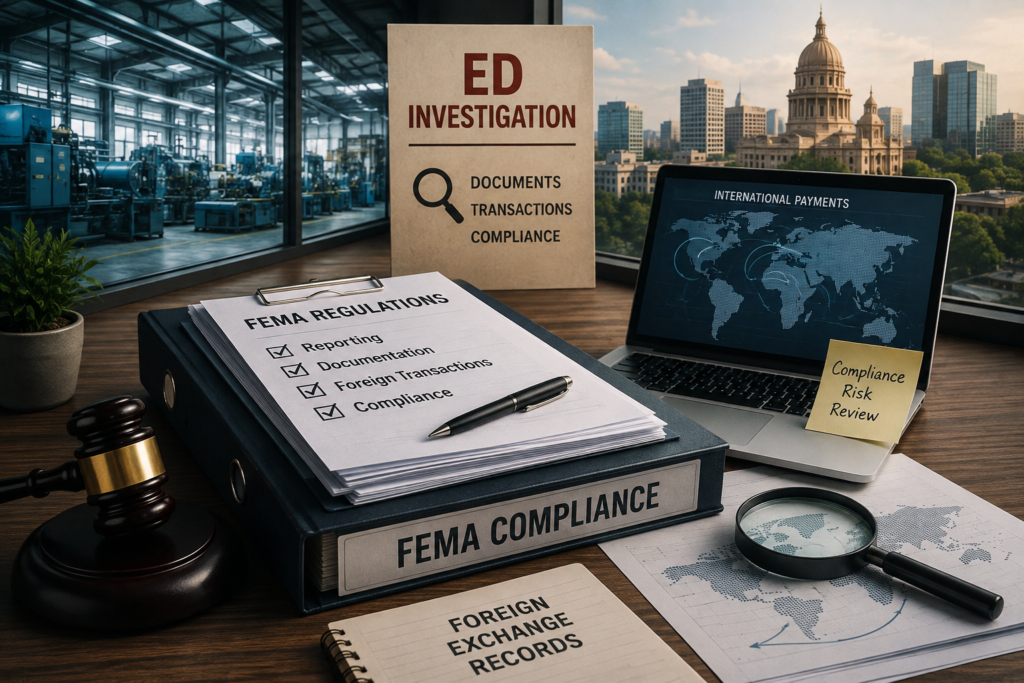
A factory or corporate office rarely faces Enforcement Directorate (ED) scrutiny because of one isolated paperwork mistake. More often, regulatory concerns develop when foreign-exchange transactions contain unresolved discrepancies, delayed reporting, incomplete documentation, or unexplained financial movements.
For companies involved in imports, exports, foreign investment, overseas investment, or international payments, FEMA compliance for businesses in Bengaluru should be treated as an ongoing risk-management responsibility rather than a one-time filing exercise.
The Directorate of Enforcement is responsible for investigating suspected contraventions of foreign-exchange laws under the Foreign Exchange Management Act, 1999 (FEMA).
For businesses operating in Bengaluru’s manufacturing, technology, export, trading, and corporate sectors, maintaining accurate records and addressing FEMA issues early can help reduce regulatory risk.
How Can a FEMA Compliance Issue Attract ED Scrutiny?
Not every FEMA reporting error results in an ED investigation. However, unresolved or unexplained foreign-exchange discrepancies can become more significant when they involve multiple transactions, missing records, inconsistent explanations, or other regulatory concerns.
Some areas that may require closer attention include:
- Delayed or incomplete foreign-exchange reporting
- Issues relating to export proceeds and realisation
- Unexplained inward or outward remittances
- Overseas Direct Investment (ODI) without complete documentation or reporting
- Missing valuation reports or corporate approvals
- Third-party payments without adequate supporting records
- Foreign investment reporting discrepancies
- Unexplained set-offs or adjustments involving international transactions
- Differences between accounting, banking, customs, and transaction records
- Transactions involving overseas entities connected with the same business group
- Foreign-exchange transactions that do not match the underlying commercial documentation
A business should not assume that a technical mistake automatically means an ED investigation is coming. The more important point is to identify discrepancies early and determine whether corrective or regulatory action is required.
This is one reason why FEMA compliance for businesses in Bengaluru should include periodic reviews of historical and current cross-border transactions.
Why Bengaluru Businesses Should Take FEMA Compliance Seriously
Bengaluru is home to a large ecosystem of technology companies, startups, manufacturers, exporters, importers, service providers, global capability centres, and businesses with overseas operations.
Many of these businesses regularly deal with:
- Foreign inward remittances
- Export payments
- Import payments
- Foreign subsidiaries
- Overseas investments
- Foreign shareholders
- Inter-company transactions
- External Commercial Borrowings
- Cross-border service payments
- International vendor and customer transactions
Each transaction can create documentation and reporting obligations under the applicable FEMA framework.
A transaction may appear correct from an accounting perspective but still require review from a FEMA compliance perspective.
For example, a company may record an overseas investment correctly in its books but fail to complete the applicable regulatory reporting. Similarly, an export transaction may be recorded in the accounting system while the corresponding realisation or regulatory records remain unresolved.
These gaps can become difficult to explain when they accumulate over several years.
Common FEMA Compliance Mistakes in Bengaluru Businesses
1. Delayed Foreign-Exchange Reporting
Foreign-exchange transactions may have specific reporting requirements and timelines.
Delayed reporting can create a compliance issue even when the underlying transaction itself was commercially genuine.
Businesses should regularly review whether applicable filings have been completed and whether supporting documents are available.
2. Export Realisation and Documentation Gaps
Exporters should maintain proper records connecting the commercial transaction with shipping documentation, invoices, banking records, and realisation of export proceeds.
Differences between these records can create questions during an internal or regulatory review.
Businesses involved in regular exports should periodically reconcile their records instead of waiting until an issue is raised.
3. ODI Reporting Issues
Overseas Direct Investment can involve multiple compliance requirements relating to approvals, valuation, reporting, financial commitments, and supporting documentation.
An ODI consultant can assist businesses in reviewing existing overseas investment transactions and identifying potential documentation or reporting gaps.
4. Foreign Investment Reporting Errors
Companies receiving foreign investment need to examine whether applicable reporting requirements have been completed correctly.
Depending on the nature of the transaction, this may involve reporting relating to the issue or transfer of securities and maintaining appropriate supporting documents.
5. Third-Party Payments
International payments involving a third party should be supported by clear commercial documentation.
The business should be able to explain:
- Who the actual parties are
- Why the payment was made
- What goods or services were involved
- Why a third party was involved
- Whether the transaction was properly documented
Unclear payment trails can make otherwise legitimate transactions difficult to explain.
6. ECB Compliance Issues
Businesses raising funds through External Commercial Borrowings (ECB) need to monitor applicable reporting and compliance requirements.
This may include reviewing borrowing documentation, utilisation, repayment, reporting, and other applicable requirements.
Companies with existing or historical ECB transactions can benefit from a structured compliance review.
What Should a Bengaluru Business Do Before Receiving an ED Notice?
Businesses should not wait for a regulatory notice to discover historical FEMA problems.
A proactive review can help identify potential issues while the business still has access to its records, finance teams, banks, consultants, and transaction documents.
A FEMA compliance health-check can include:
Review Bank Transactions
Map inward and outward foreign-exchange transactions against the underlying invoices, agreements, remittance details, and purpose of payment.
Reconcile Export Records
Review export documentation, bank records, applicable regulatory records, and realisation of export proceeds.
Review Foreign Investments
Check whether foreign investment transactions have been appropriately documented and reported.
Review Overseas Investments
Examine ODI documentation, valuation, approvals, reporting, and financial commitment records.
Review ECB Transactions
Where applicable, verify borrowing documentation, reporting, utilisation, and repayment records.
Check Historical Compliance
Do not restrict the review to the current financial year. Older transactions can also create compliance questions if they remain unresolved.
Identify Potential Contraventions
Once an issue is identified, obtain professional advice on whether it can be corrected, regularised, or compounded under the applicable framework.
The RBI’s current FAQ explains that compounding is a voluntary process for eligible FEMA contraventions, subject to the applicable law and rules. It also states that certain cases are not eligible for RBI compounding.
Can FEMA Contraventions Be Compounded?
In certain circumstances, eligible FEMA contraventions can be addressed through the compounding mechanism.
Under Section 15 of FEMA, eligible contraventions may be compounded by the appropriate authority. The applicable process depends on the nature of the contravention and the relevant rules.
Businesses should therefore avoid assuming that every FEMA issue can simply be resolved by paying a penalty.
The RBI’s current guidance states that a person who becomes aware of a FEMA contravention may apply for compounding, subject to eligibility and applicable requirements.
The Enforcement Directorate has also published recent examples where FEMA proceedings were subsequently compounded following the applicable process and RBI action.
The important point is to identify the issue and obtain appropriate professional advice as early as possible.
What Happens If FEMA Records Do Not Match?
One of the biggest compliance challenges for businesses with international operations is inconsistency between different records.
For example:
Accounting records may show one amount.
Bank records may show another description.
Export or import documentation may contain different information.
Regulatory filings may not have been updated.
Internal emails and agreements may contain additional information.
None of these differences automatically proves wrongdoing. However, they can make a transaction difficult to explain.
This is why businesses should maintain a consistent documentary trail for significant cross-border transactions.
What Records Should Bengaluru Businesses Maintain?
Depending on the transaction, businesses should maintain relevant records such as:
- Commercial agreements
- Invoices
- Purchase orders
- Shipping documents
- Bank statements
- Remittance documents
- Board resolutions
- Valuation reports
- Regulatory filings
- Investment records
- Accounting entries
- Correspondence with banks
- Supporting emails
- Transaction approvals
- Other documents supporting the commercial purpose
Good record-keeping is especially important when transactions involve related parties, overseas subsidiaries, foreign shareholders, or complex payment structures.
What Are the Risks of FEMA Non-Compliance?
The consequences depend on the nature and circumstances of the contravention.
FEMA provides for monetary penalties for contraventions, and ED has investigative and adjudicatory responsibilities in relation to suspected FEMA violations.
Businesses may also face:
- Regulatory proceedings
- Financial penalties
- Prolonged compliance reviews
- Management time spent responding to queries
- Difficulty reconstructing old transactions
- Business disruption
- Reputational concerns
For this reason, proactive FEMA compliance for businesses in Bengaluru can be an important part of financial and regulatory risk management.
How FEMABIDE Advisorz Helps Businesses in Bengaluru
FEMABIDE Advisorz provides FEMA-related advisory and compliance support for businesses dealing with foreign-exchange transactions.
Our services include:
- FEMA compliance reviews
- FEMA health-checks
- FDI advisory
- ODI advisory
- ECB compliance support
- Foreign-exchange transaction reviews
- Regulatory reporting assistance
- FEMA compounding support
- Representation and advisory
- Historical transaction review
Whether your business is an exporter, manufacturer, technology company, startup, trading company, or group entity with overseas transactions, identifying compliance gaps early can make them easier to address.
If your business operates in Bengaluru and you have unresolved foreign-exchange transactions, delayed filings, overseas investment issues, export realisation concerns, or other FEMA-related questions, a professional compliance review can help you understand your current position.
Frequently Asked Questions
What is FEMA compliance for businesses in Bengaluru?
FEMA compliance involves following the applicable foreign-exchange laws, rules, regulations, directions, reporting requirements, and procedures for transactions involving foreign exchange, cross-border payments, foreign investment, exports, imports, ODI, and other relevant transactions.
Can a FEMA issue lead to an ED investigation?
A FEMA contravention can come within the investigative jurisdiction of the Enforcement Directorate. However, an individual compliance error does not automatically result in an ED investigation. The circumstances, nature of the transaction, available information, and other factors are relevant.
What FEMA issues commonly affect exporters?
Exporters may encounter issues involving export realisation, documentation, reporting delays, inconsistencies between banking and export records, and other foreign-exchange compliance requirements.
Why should Bengaluru companies conduct a FEMA compliance review?
Businesses involved in international transactions can accumulate compliance gaps over time. A periodic review can help identify documentation problems, reporting delays, inconsistencies, and potential contraventions before they become more difficult to address.
Can old FEMA violations be regularised?
Some eligible FEMA contraventions may be addressed through applicable regularisation or compounding mechanisms. Eligibility depends on the specific facts and applicable rules. Professional advice should be obtained before choosing a corrective route.
What documents are needed for a FEMA compliance review?
Depending on the transaction, a review may require bank statements, invoices, agreements, shipping documents, regulatory filings, investment records, valuation reports, board approvals, accounting records, and other supporting documentation.
When should a company seek FEMA advisory support?
Businesses should consider seeking professional advice when they identify delayed filings, unexplained foreign-exchange transactions, export realisation issues, ODI or FDI reporting gaps, ECB compliance concerns, or inconsistencies between financial and regulatory records.
Final Takeaway
An ED investigation does not necessarily begin with a major financial irregularity. Regulatory concerns can develop when foreign-exchange transactions remain unexplained, inconsistently documented, or unresolved over time.
For exporters, manufacturers, technology companies, and other businesses handling international transactions, proactive FEMA compliance for businesses in Bengaluru can help identify potential issues before they become more difficult to manage.
The objective is not simply to respond when a regulator asks questions.
It is to make sure your business can confidently explain its foreign-exchange transactions, documentation, and regulatory filings when required.
If your Bengaluru business has unresolved FEMA compliance issues, consider conducting a professional FEMA compliance health-check before the issue escalates.
Visit https://femabide.com/ to learn more about FEMABIDE Advisorz and its FEMA compliance and advisory services.