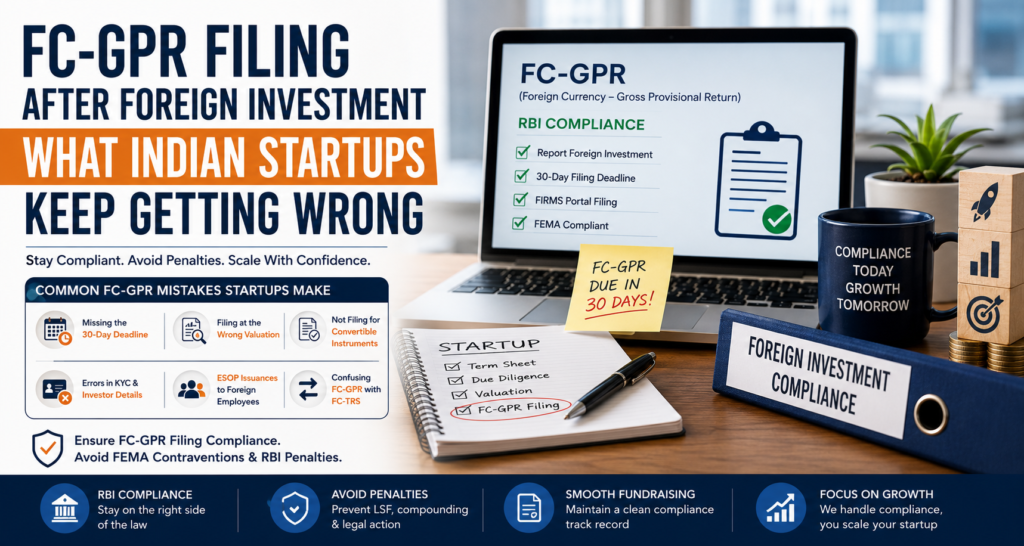
FC-GPR Filing FEMA Indian Startups Must Get Right
The biggest mistake most founders make after raising foreign capital is ignoring the FC-GPR filing FEMA Indian startups are legally required to complete under FEMA regulations.
You have successfully raised funding, signed the term sheet, closed the transaction, and received the foreign investment. But many startups fail at the next critical stage — FEMA compliance.
Under Indian foreign exchange laws, Form FC-GPR is not optional. Missing the filing deadline, filing incorrect details, or misunderstanding RBI requirements can turn a successful fundraising round into a FEMA contravention.
At FEMABIDE Advisorz, we regularly assist startups with delayed FC-GPR filings, FEMA regularisation, RBI compounding applications, and foreign investment compliance reviews.
This guide explains the most common Form FC-GPR errors Indian startups make and how to avoid costly RBI penalties.
What is Form FC-GPR?
Form FC-GPR (Foreign Currency Gross Provisional Return) is the mandatory RBI reporting form filed when an Indian company issues equity instruments to a person resident outside India.
The filing is completed through the RBI FIRMS portal and forms a crucial part of FDI reporting India compliance requirements.
The FC-GPR filing requirement applies to:
- Equity shares
- Compulsorily Convertible Debentures (CCDs)
- Compulsorily Convertible Preference Shares (CCPS)
- Other eligible equity instruments issued to foreign investors
Every startup receiving foreign investment must understand the FC-GPR filing FEMA Indian startups are obligated to complete within strict timelines.
Mistake #1: Missing the FC-GPR Filing Deadline
The most common mistake under FC-GPR filing deadline FEMA rules is missing the 30-day reporting timeline.
Under FEMA regulations, FC-GPR must be filed within 30 days from the date of allotment of shares to the foreign investor.
Many founders mistakenly believe:
- The timeline starts from receipt of funds
- Legal counsel has already handled the filing
- The filing can wait until post-closing formalities are completed
This delay creates direct FEMA non-compliance.
Even a one-day delay can trigger:
- Late Submission Fees (LSF)
- RBI scrutiny
- FEMA contravention proceedings
- RBI compounding requirements
At FEMABIDE Advisorz, we frequently help startups regularise delayed FC-GPR filings through the RBI compounding process.
Mistake #2: Incorrect Valuation Reporting
Another major issue under FC-GPR RBI compliance involves incorrect share valuation.
Under FEMA pricing guidelines:
- Shares cannot be issued below fair market value
- Valuation must comply with FEMA pricing regulations
- Unlisted companies typically require valuation certification from a Chartered Accountant or Merchant Banker
Many startups adopt international venture capital structures without checking FEMA pricing implications in India.
This often results in:
- Incorrect valuation disclosures
- FEMA pricing violations
- FC-GPR rejection on the FIRMS portal
- Regulatory scrutiny during future funding rounds
Proper valuation documentation is a critical part of foreign investment India FEMA compliance.
Mistake #3: Ignoring Convertible Instruments
Many founders wrongly assume FC-GPR applies only to equity shares.
This is incorrect.
FC-GPR filing requirements also apply to:
- CCDs
- CCPS
- Other convertible instruments issued to non-residents
This is one of the most common FEMA startup compliance mistakes seen in venture-funded companies.
Failure to report convertible instruments properly may later create issues during due diligence, future fundraising, or acquisition transactions.
Mistake #4: Errors in Investor KYC Documentation
Incorrect investor documentation remains one of the top reasons for FIRMS portal rejection.
Common mistakes include:
- Wrong country codes
- Missing investor KYC
- Incorrect beneficial ownership details
- Missing UIN references
- Incorrect investment route selection
Under FC-GPR filing FEMA Indian startups regulations, even minor documentation errors can delay approval and push filings beyond the permitted timeline.
Startups should ensure all investor KYC documentation is verified before share allotment.
Mistake #5: ESOP Reporting Errors
Cross-border ESOP structures are another major compliance risk.
Many startups treat employee stock options as purely HR-related matters and overlook FEMA reporting obligations.
However, when equity in an Indian company is issued to non-residents, FEMA compliance obligations may arise.
This is especially relevant for:
- Foreign employees receiving Indian ESOPs
- Overseas subsidiary employees holding Indian equity
- Cross-border startup holding structures
Improper handling of these structures can trigger significant FEMA compliance for companies issues.
Mistake #6: Confusing FC-GPR with FC-TRS
One of the most frequent startup mistakes is confusing FC-GPR with FC-TRS.
The difference is simple:
- FC-GPR applies to fresh issue of shares
- FC-TRS applies to transfer of shares between resident and non-resident parties
During startup funding rounds involving secondary sales, founders often complete only FC-GPR and completely miss FC-TRS reporting obligations.
This creates additional FEMA exposure.
How Indian Startups Should Handle FC-GPR Filing Properly
The best way to manage FC-GPR filing FEMA Indian startups compliance is to build FEMA reporting into the investment closing process itself.
Key steps include:
- Complete valuation before allotment
- Collect investor KYC in advance
- Prepare FIRMS portal access beforehand
- Coordinate with FEMA advisors before closing
- Track the 30-day filing deadline carefully
The allotment date is the trigger date under FEMA — not the term sheet date or fund receipt date.
Already Missed Your FC-GPR Filing?
If your startup has already delayed FC-GPR filing, RBI compounding may be required.
The good news is that delayed FC-GPR filings are among the most common FEMA contraventions handled by the RBI.
At FEMABIDE Advisorz, we assist startups with:
- FEMA compliance review
- RBI compounding applications
- FC-GPR regularisation
- FIRMS portal support
- FDI reporting corrections
- FEMA advisory for startups
Early action significantly reduces compliance risks and helps maintain a clean regulatory record for future funding rounds.
FAQs on FC-GPR Filing for Indian Startups
What is FC-GPR filing under FEMA?
FC-GPR is the RBI reporting form filed when an Indian company issues shares or convertible instruments to a foreign investor under FEMA regulations.
What is the FC-GPR filing deadline?
Under FEMA regulations, FC-GPR must generally be filed within 30 days from the date of allotment of shares.
Is FC-GPR mandatory for startups receiving FDI?
Yes. Every Indian startup receiving foreign investment through eligible equity instruments must comply with FC-GPR filing requirements.
What happens if FC-GPR is filed late?
Delayed filing may result in Late Submission Fees (LSF), FEMA contravention proceedings, and RBI compounding requirements.
Is FC-GPR required for CCDs and CCPS?
Yes. FC-GPR applies to compulsorily convertible instruments issued to non-residents.
What is the difference between FC-GPR and FC-TRS?
FC-GPR is for fresh issue of shares to non-residents, while FC-TRS applies to transfer of shares between resident and non-resident parties.
Can RBI reject FC-GPR filings?
Yes. Incorrect valuation, incomplete KYC documentation, or filing errors can result in rejection on the FIRMS portal.
How can FEMABIDE Advisorz help startups?
FEMABIDE Advisorz assists startups with FEMA compliance, FC-GPR filing, RBI compounding, FIRMS portal filings, and foreign investment advisory services.