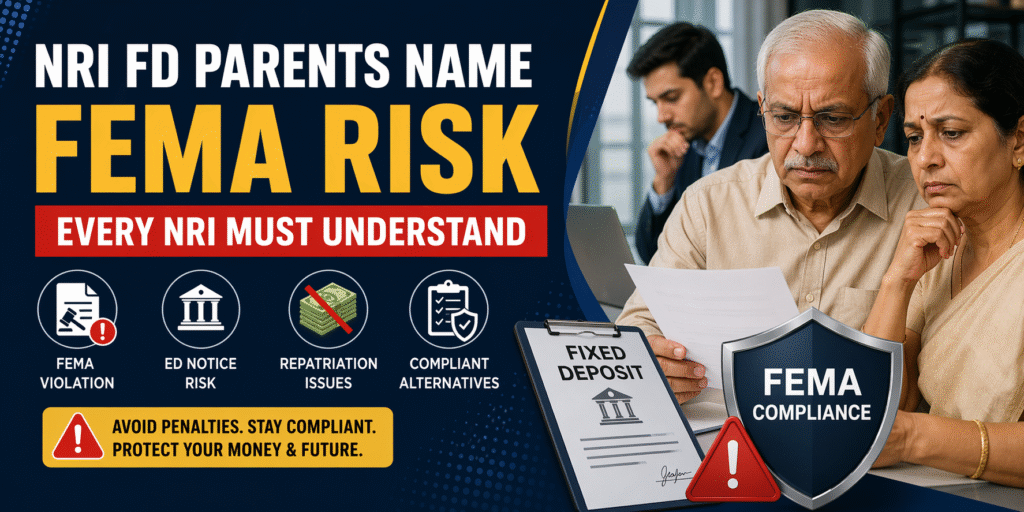
Many NRIs believe that keeping fixed deposits in their parents’ names is a simple and safe financial strategy. While it may look convenient, the NRI FD parents name FEMA issue is becoming a major compliance concern in India. What appears to be a family arrangement can actually lead to serious regulatory consequences if not structured correctly.
Why NRI FD Parents Name FEMA Practice Is So Common
The FEMA situation arises because of practical intentions. NRIs often want to support their parents, manage money easily in India, and sometimes reduce tax liability. However, lack of awareness about FEMA rules leads to incorrect structuring of these deposits.
This common practice is now under increased scrutiny by authorities, making it important for NRIs to understand the risks involved.
NRI FD Parents Name FEMA and FEMA Violation Risk
Under FEMA regulations, transferring large funds to a resident individual and creating fixed deposits in their name can be treated as a compliance violation. The FEMA structure may be classified as:
Unauthorized remittance
Indirect lending to a resident
Improper use of banking channels
This is where many NRIs unknowingly fall into a FEMA violation category.
How NRI FD Parents Name FEMA Can Lead to ED Notice
Authorities like the Enforcement Directorate monitor high-value transactions involving NRIs. The NRI FD parents name FEMA issue becomes serious when transactions are flagged during scrutiny.
Possible consequences include:
Show cause notice under FEMA
Heavy financial penalties
Freezing of bank accounts
Legal proceedings for both NRI and parents
An ED notice in India can come years after the transaction, which makes this risk even more dangerous.
FEMA and Repatriation Problems
Apart from compliance risk, the NRI FD FEMA structure creates long-term financial complications.
NRIs may face:
Difficulty in repatriating funds abroad
Inheritance disputes after parents’ lifetime
Complex documentation requirements
Tax issues on inherited deposits
This turns a simple financial decision into a complicated legal situation.
NRI FD Parents Name FEMA Safe Alternatives for Compliance
To avoid the FEMA risk, NRIs should follow compliant investment options.
Use NRE fixed deposits which are fully repatriable and tax-free
Choose FCNR deposits to avoid currency risk
Keep NRI funds separate from resident accounts
Ensure proper documentation and nomination
These options are designed specifically to maintain FEMA compliance for NRI investments.
Why NRI FD Parents Name FEMA Needs Expert Review
Many NRIs assume their structure is safe because no issue has occurred yet. However, the NRI FD parents name FEMA problem usually appears later during audits or investigations.
Consulting a FEMA expert helps:
Identify hidden compliance risks
Correct existing FD structures
Avoid penalties and legal issues
Ensure smooth repatriation in the future
FAQs
Is NRI FD parents name FEMA allowed in India
No, it is risky if not structured properly and can lead to FEMA violations.
Can NRIs transfer money to parents legally
Yes, but using that money for investments like FDs without compliance can create issues.
What is the safest FD option for NRIs
NRE and FCNR deposits are the safest and fully compliant options.
Can NRI repatriate money from parents account easily
No, repatriation is complex and involves strict documentation.
What happens if FEMA violation is detected
Penalties, account freezing, and legal action may follow.
How to avoid NRI FD parents name FEMA risk
Use proper NRI accounts, avoid mixing funds, and consult a FEMA expert.
Conclusion
The NRI FD parents name FEMA issue is one of the most overlooked compliance risks today. With increasing regulatory checks, NRIs must ensure that their financial arrangements are fully compliant rather than convenient.