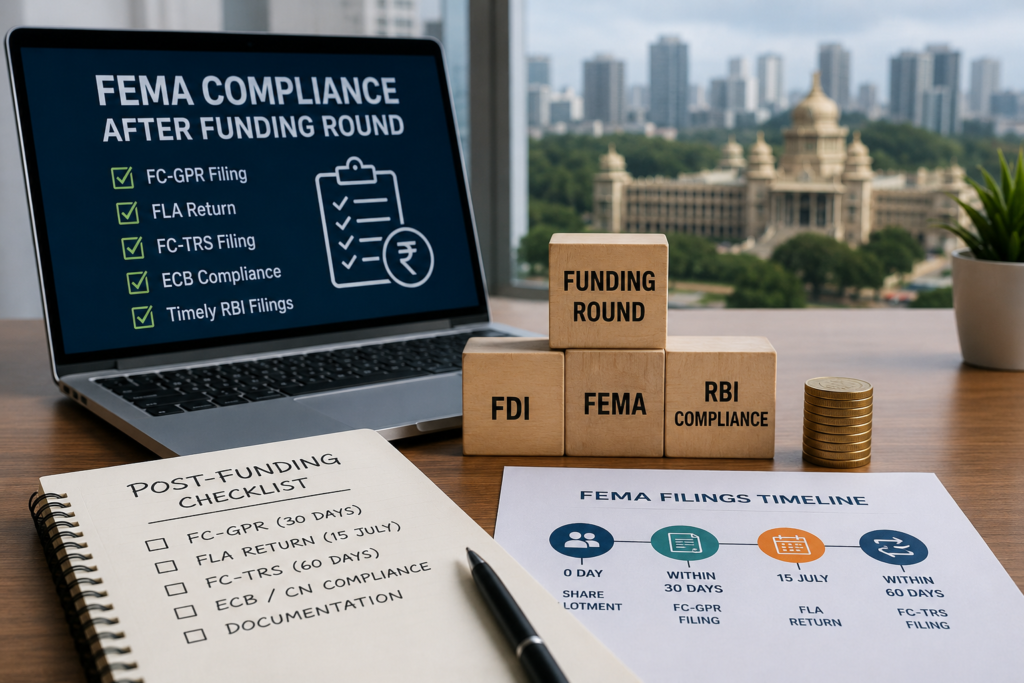
Closing a funding round is one of the most significant milestones in a startup’s journey. For founders in Bangalore and Bengaluru, the weeks after closing are typically consumed by product roadmaps, hiring plans, and investor updates. What most founders do not realise is that the clock on a set of mandatory FEMA filings after funding round Bangalore startup begins running from the moment shares are allotted to a foreign investor.
FEMABIDE Advisorz is a specialist FEMA consulting firm based in Hyderabad providing FEMA advisory services to startups across Bengaluru, Hyderabad, Telangana, Andhra Pradesh, Visakhapatnam, Vijayawada, and Chennai. In this guide, we explain the five mandatory FEMA filings every Bangalore startup should understand after closing a foreign investment round.
Why 30 Days Matters Under FEMA
The Foreign Exchange Management Act, 1999 and the regulations issued under it by the Reserve Bank of India impose strict timelines on Indian companies receiving Foreign Direct Investment (FDI). The most critical requirement is filing Form FC-GPR within 30 days of share allotment to a foreign investor.
Missing this deadline is not a simple administrative oversight. It is treated as a FEMA contravention that may require an RBI compounding application, attract monetary penalties, and create compliance gaps that future investors will identify during due diligence. Bangalore startups receiving foreign funding frequently appear in RBI compounding orders because of delayed filings.
Stage 1: Inward Remittance Reporting Through Your Authorised Dealer Bank
The first compliance step begins when foreign investment reaches your company’s bank account. Every Bangalore startup receiving FDI must report the inward remittance through its Authorised Dealer (AD) Bank.
Your AD Bank issues a Foreign Inward Remittance Certificate (FIRC) confirming receipt of funds. This document forms the foundation for every subsequent FEMA filing. Without a valid FIRC, your FC-GPR filing cannot be completed through the RBI FIRMS Portal.
Startups receiving investment through fintech platforms or payment intermediaries instead of direct SWIFT transfers often face documentation challenges. Engaging a FEMA consultant at this stage helps ensure the FIRC is correctly obtained.
Stage 2: Form FC-GPR on the FIRMS Portal Within 30 Days
Form FC-GPR (Foreign Currency-Gross Provisional Return) is the most important RBI filing for companies issuing equity instruments to non-resident investors. It is also the most commonly missed compliance requirement for funded startups.
The 30-day deadline starts from the date of share allotment, not from the date funds are received or the term sheet is signed. Many founders mistakenly calculate the timeline from the wrong date and unknowingly miss the statutory deadline.
An FC-GPR filing generally requires:
- Complete KYC documents for every foreign investor
- Foreign Inward Remittance Certificate (FIRC)
- Valuation Certificate issued by a Chartered Accountant or SEBI-registered Merchant Banker
- Unique Identification Number (UIN) on the FIRMS Portal
- Details of shares issued, including class, number, and issue price
Incomplete KYC documentation is one of the most common reasons for FC-GPR rejection. Since the statutory timeline continues even if the application is rejected, startups should complete investor documentation before share allotment.
Stage 3: FLA Annual Return
If your startup has received foreign investment or made overseas investments, filing the Foreign Liabilities and Assets (FLA) Annual Return is mandatory.
The FLA Return must generally be filed by 15 July each year based on the company’s foreign assets and liabilities as of 31 March.
For Bangalore startups that closed funding before the financial year-end, missing the FLA Return creates an independent FEMA contravention separate from FC-GPR. During Series A or later-stage due diligence, missed FLA filings are among the most common historical compliance issues identified by FEMA consultants.
Stage 4: Form FC-TRS for Secondary Share Transfers
Many startup funding rounds include both primary investment and secondary share sales by founders or existing shareholders.
Whenever shares are transferred between a resident and a non-resident, Form FC-TRS must be filed within the prescribed timeline.
FC-GPR applies to fresh issue of shares, whereas FC-TRS applies to transfers of existing shares. Both filings may be required in the same funding round depending on the transaction structure.
Stage 5: ECB Compliance for Convertible Notes and Shareholder Loans
Not all foreign investments are structured as equity. Some Bangalore startups receive funding through convertible notes, debentures or shareholder loans.
Where funding qualifies as an External Commercial Borrowing (ECB), compliance begins before the first drawdown. Companies are generally required to obtain a Loan Registration Number (LRN) through their AD Bank by filing Form ECB.
Where convertible notes are issued, Form CN must be filed. Once those notes convert into equity, Form FC-GPR must again be filed within 30 days of share allotment following conversion.
Many startups overlook this second FC-GPR filing because the conversion often happens months or years after the original investment.
What Happens If Bangalore Startups Miss FEMA Filings?
Missing FEMA filing deadlines can have significant legal and commercial consequences.
The RBI publishes compounding orders on its website, making compliance failures publicly available. During future fundraising, mergers, acquisitions or investor due diligence, these records are routinely reviewed.
Delayed FC-GPR filings, missed FLA Returns, incorrect inward remittance reporting and delayed FC-TRS filings are among the most common FEMA violations observed in funded startups.
Fortunately, eligible violations can often be regularised through the RBI compounding process.
How FEMABIDE Advisorz Helps Bangalore Startups
FEMABIDE Advisorz is a specialist FEMA consulting firm providing FEMA Act, 1999 advisory services to startups across Bangalore, Bengaluru, Hyderabad, Telangana, Andhra Pradesh, Chennai, Visakhapatnam and Vijayawada.
Our services include:
- FC-GPR Filing
- FLA Annual Return
- FC-TRS Filing
- ECB Compliance
- ODI Compliance
- FEMA Due Diligence
- RBI Compounding Applications
- FEMA Advisory for Funded Startups
Whether you are closing your first seed round or preparing for Series A investment, our experts ensure your post-funding FEMA compliance is completed accurately, on time and in accordance with RBI regulations.
Frequently Asked Questions (FAQs)
1. What are the mandatory FEMA filings after a funding round for a Bangalore startup?
After receiving foreign investment, startups generally need to complete inward remittance reporting through their AD Bank, file Form FC-GPR, submit the FLA Annual Return (where applicable), file Form FC-TRS for secondary share transfers, and comply with ECB regulations if funding includes loans or convertible instruments.
2. What is the deadline for filing Form FC-GPR?
Form FC-GPR must generally be filed within 30 days from the date of share allotment to a foreign investor.
3. Is FC-GPR mandatory for every foreign investment?
Yes. Whenever an Indian company issues equity instruments to a non-resident under the FDI route, Form FC-GPR is generally required.
4. What happens if FEMA filing deadlines are missed?
Delayed filings may result in RBI compounding proceedings, monetary penalties, compliance issues during investor due diligence, and delays in future fundraising or acquisitions.
5. What is the FLA Annual Return?
The Foreign Liabilities and Assets (FLA) Return is an annual RBI filing required from companies that have received foreign investment or made overseas investments.
6. When is Form FC-TRS applicable?
Form FC-TRS is applicable when existing shares are transferred between a resident and a non-resident, including secondary transactions during funding rounds.
7. Do convertible notes require FEMA compliance?
Yes. Convertible notes may require Form CN, ECB compliance where applicable, and Form FC-GPR upon conversion into equity.
8. Can FEMA violations be regularised?
Yes. Certain FEMA contraventions can be regularised through the RBI’s compounding mechanism by filing a compounding application and paying the applicable penalty.
9. Why should startups hire a FEMA consultant?
A FEMA consultant helps ensure all RBI filings are completed correctly and within statutory timelines, reducing the risk of penalties and future compliance issues.
10. How can FEMABIDE Advisorz help funded startups?
FEMABIDE Advisorz provides comprehensive FEMA compliance services, including FC-GPR filing, FLA Return, FC-TRS filing, ECB compliance, ODI compliance, FEMA due diligence and RBI compounding assistance for startups across Bangalore, Bengaluru, Hyderabad, Telangana, Andhra Pradesh, Chennai, Visakhapatnam and Vijayawada.
Conclusion
Completing a funding round is only the beginning of your compliance journey. Understanding the FEMA filings after funding round Bangalore startup requirements is essential to avoid penalties, maintain investor confidence and ensure smooth future fundraising.
FEMABIDE Advisorz assists funded startups with end-to-end FEMA compliance, helping founders meet every RBI requirement accurately and within the prescribed timelines.
Book your post-funding FEMA compliance review today.