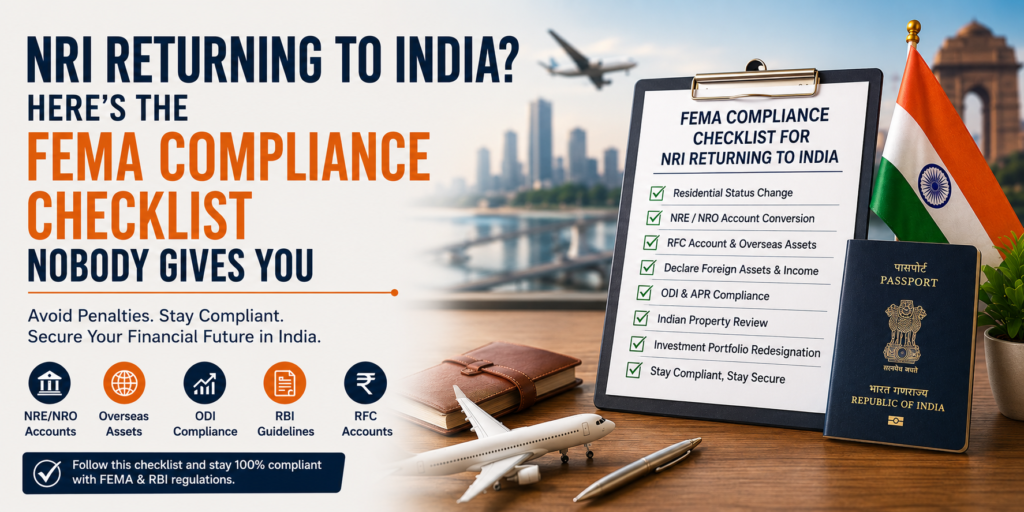
FEMA Compliance Checklist for NRI Returning to India
The FEMA compliance checklist for NRI returning to India is one of the most overlooked legal and financial requirements for NRIs planning to settle back in India. Every year, thousands of NRIs return home for retirement, family, business opportunities, or long-term settlement, but many fail to understand that their FEMA obligations change immediately after their residential status changes.
Under the NRI returning to India FEMA regulations, the moment your intent changes from temporary stay abroad to permanent or uncertain stay in India, your financial structure must also change. This includes bank accounts, overseas investments, property holdings, foreign income disclosures, and RBI reporting obligations.
At FEMABIDE Advisorz, we regularly assist returning NRIs who unknowingly continued operating NRE accounts, foreign investments, or overseas structures in ways that became non-compliant under FEMA after returning to India.
This detailed FEMA compliance checklist for NRI returning to India explains the essential actions every returning NRI must take to avoid RBI scrutiny, Enforcement Directorate notices, and FEMA contraventions.
Indian startups receiving foreign investment must prioritise FEMA compliance for companies to avoid RBI penalties, delayed funding approvals, and future regulatory complications.
Step 1: Understand When Your NRI Status Changes Under FEMA
One of the biggest misconceptions among returning NRIs is assuming that FEMA follows the same residency rules as the Income Tax Act.
It does not.
Under FEMA, your residential status changes based on your intention to stay in India, not merely the number of days spent in the country. If you return to India with the intention of permanent settlement or for an uncertain period, you may immediately become a Person Resident in India (PRII).
This NRI status change FEMA rule is extremely important because from that moment onward, your banking arrangements, investments, and foreign exchange transactions must comply with resident Indian regulations.
Many NRIs mistakenly wait for the 182-day rule under income tax provisions and continue operating NRE accounts during this period, creating unintended FEMA violations.
Step 2: Convert Your NRE and NRO Accounts Immediately
One of the most critical parts of the FEMA compliance checklist for NRI returning to India is redesignating your bank accounts after your residential status changes.
Once you become a resident under FEMA:
- Your NRE account must be converted into a Resident Rupee Savings Account
- Your NRO account must be redesignated as a Resident Account
- FCNR deposits may continue till maturity but cannot be renewed as FCNR deposits afterward
The issue of NRE NRO account returning India violations is one of the most common compliance problems faced by returning NRIs.
Continuing to use NRE accounts after becoming a resident Indian is considered a FEMA contravention. Although banks conduct periodic reviews, the responsibility to inform the bank about your status change ultimately rests with the account holder.
Step 3: Handle Overseas Bank Accounts and Foreign Assets Properly
A crucial aspect of FEMA rules for returning NRI individuals involves managing foreign bank accounts and overseas assets correctly after becoming a resident Indian.
Returning NRIs are generally permitted to retain:
- Overseas bank accounts opened during NRI status
- Foreign stocks and mutual funds
- Overseas real estate
- Business interests outside India
However, compliance obligations change significantly after returning.
You may need to:
- Route eligible foreign income through an RFC account
- Ensure proper reporting of overseas assets
- Maintain documentation for foreign investments
- Review repatriation rules applicable to resident Indians
An RFC (Resident Foreign Currency) account is particularly useful for returning NRIs because it allows holding foreign currency legally in India without requiring RBI permission.
Failure to restructure overseas income handling is one of the major areas where RBI compliance NRI issues arise.
Step 4: Declare Foreign Assets and Overseas Income
Many returning NRIs are unaware that once they become resident Indians, disclosure obligations increase substantially.
Under Indian regulations, overseas assets and foreign income may require reporting in income tax disclosures. These disclosures can include:
- Foreign bank accounts
- Overseas securities
- International mutual funds
- Foreign properties
- Business ownership outside India
- Loans and receivables from overseas entities
The FEMA compliance checklist for NRI returning to India must include a detailed review of all foreign holdings to ensure proper disclosure and reporting.
Failure to disclose foreign assets can trigger scrutiny from regulatory authorities and create long-term compliance complications.
Step 5: Review Overseas Direct Investments (ODI)
Another major area under FEMA compliance for returning NRIs involves Overseas Direct Investment regulations.
If you make overseas investments after becoming a resident Indian, the ODI framework applicable to resident Indians becomes relevant. These rules are often more stringent than the rules that applied during your NRI status.
This includes:
- Compliance under ODI regulations
- Reporting obligations to authorised dealers
- Filing Annual Performance Reports (APRs)
- Monitoring overseas shareholding structures
Non-filing of APRs remains one of the most common FEMA violations identified during compliance reviews.
At FEMABIDE Advisorz, we regularly assist clients in identifying ODI non-compliances and handling RBI compounding applications for past contraventions.
Step 6: Review Indian Properties Purchased as an NRI
Properties purchased while you were an NRI generally remain valid and legally held after your return to India.
However, future transactions involving those assets may now fall under resident Indian FEMA rules.
This becomes especially important for:
- Sale proceeds repatriation
- Property purchased using NRE funds
- Joint ownership structures
- Rental income compliance
- Property inheritance planning
Returning NRIs should conduct a proper review of their Indian real estate holdings as part of their FEMA compliance checklist for NRI returning to India.
Step 7: Redesignate Your Investment Portfolio
Many NRIs continue operating NRI-specific investment structures even after returning to India, often without realising this creates technical FEMA non-compliance.
This includes:
- PIS accounts
- NRI demat accounts
- NRI mutual fund folios
- NRI trading accounts
After becoming resident in India, these investments usually require redesignation into resident accounts.
The issue is particularly common in cases involving long-term equity investments where account updates were never completed after returning.
Why Returning NRIs Should Act Immediately
One important aspect of FEMA rules for returning NRI individuals is that FEMA does not provide a formal grace period for account redesignation or restructuring.
In practice, authorities may differentiate between genuine administrative delay and deliberate non-compliance. However, prolonged inaction can significantly increase regulatory risk.
Many individuals only discover these issues years later during:
- RBI scrutiny
- Bank KYC reviews
- Property transactions
- Overseas remittances
- Income tax assessments
- Enforcement Directorate inquiries
The best approach is to complete your compliance review immediately upon returning to India.
How FEMABIDE Advisorz Helps Returning NRIs
FEMABIDE Advisorz provides specialised FEMA advisory services for returning NRIs across India and globally.
Our services include:
- FEMA compliance review for returning NRIs
- NRE/NRO/RFC account restructuring guidance
- ODI compliance advisory
- RBI compounding support
- FEMA contravention regularisation
- Overseas asset compliance review
- FEMA strategy for global investments
We help NRIs identify hidden compliance risks before they become serious regulatory issues.
Frequently Asked Questions (FAQs)
What is the FEMA compliance checklist for NRI returning to India?
The FEMA compliance checklist for NRI returning to India includes redesignating NRE/NRO accounts, reviewing overseas assets, restructuring investments, opening RFC accounts where necessary, and ensuring proper RBI and FEMA compliance after becoming a resident Indian.
When does NRI status change under FEMA?
Under FEMA, your residential status changes when you return to India with the intention of staying permanently or for an uncertain duration. It does not depend solely on the 182-day rule used under income tax laws.
Can I continue using my NRE account after returning to India?
No. Once your residential status changes under FEMA, your NRE account must be redesignated as a resident account. Continuing to operate it as an NRE account may become a FEMA contravention.
What happens to FCNR deposits after returning to India?
Existing FCNR deposits can generally continue till maturity, but they cannot usually be renewed as FCNR deposits after you become a resident Indian.
Can returning NRIs keep foreign bank accounts?
Yes. Returning NRIs are generally permitted to retain foreign bank accounts opened during their NRI period, subject to FEMA rules and proper disclosure requirements.
What is an RFC account for returning NRIs?
An RFC (Resident Foreign Currency) account allows returning NRIs to legally hold foreign currency in India after becoming residents.
Are overseas assets required to be disclosed after returning to India?
Yes. Resident Indians may need to disclose foreign assets and overseas income in their tax filings and compliance documentation.
What are common FEMA violations by returning NRIs?
Common violations include continuing NRE accounts after becoming residents, failure to redesignate investment accounts, non-disclosure of foreign assets, and ODI reporting failures.