What Is Press Note 3 (2020)?
Press Note 3 (2020 Series) was issued by the Department for Promotion of Industry and Internal Trade (DPIIT) on 17 April 2020. It amended the foreign direct investment (FDI) policy to address the risk of opportunistic takeovers or acquisitions of Indian companies during the COVID-19 economic disruption.
The key change was to require certain investments connected with countries sharing a land border with India to follow the Government route, rather than the automatic route.
The original Press Note 3 framework covered investments from entities incorporated in land-border countries and investments where the beneficial owner was situated in or a citizen of such a country. The rule was subsequently given statutory effect through amendments to the Foreign Exchange Management (Non-Debt Instruments) Rules, 2019.
Importantly, the framework has evolved. In March 2026, DPIIT issued Press Note No. 2 (2026 Series) to revise the beneficial-ownership provisions, and the corresponding FEMA amendment took effect from May 2, 2026.
Therefore, businesses and investors should assess Press Note 3 using the current 2026 framework, rather than relying only on the original 2020 wording.
What Is the Core Press Note 3 Restriction?
Under the current framework, an entity or citizen of a country sharing a land border with India can invest in India only through the Government route.
The same Government-route restriction applies where the beneficial ownership of the investment falls within the specified land-border-country criteria.
The current rules also address subsequent changes in ownership. If a direct or indirect transfer of existing or future FDI results in beneficial ownership falling within the restricted category, prior Government approval is required.
This means that checking only the immediate foreign investor may not be sufficient. Companies may also need to examine the investor’s ownership, control and beneficial ownership structure.
Which Countries Share a Land Border With India?
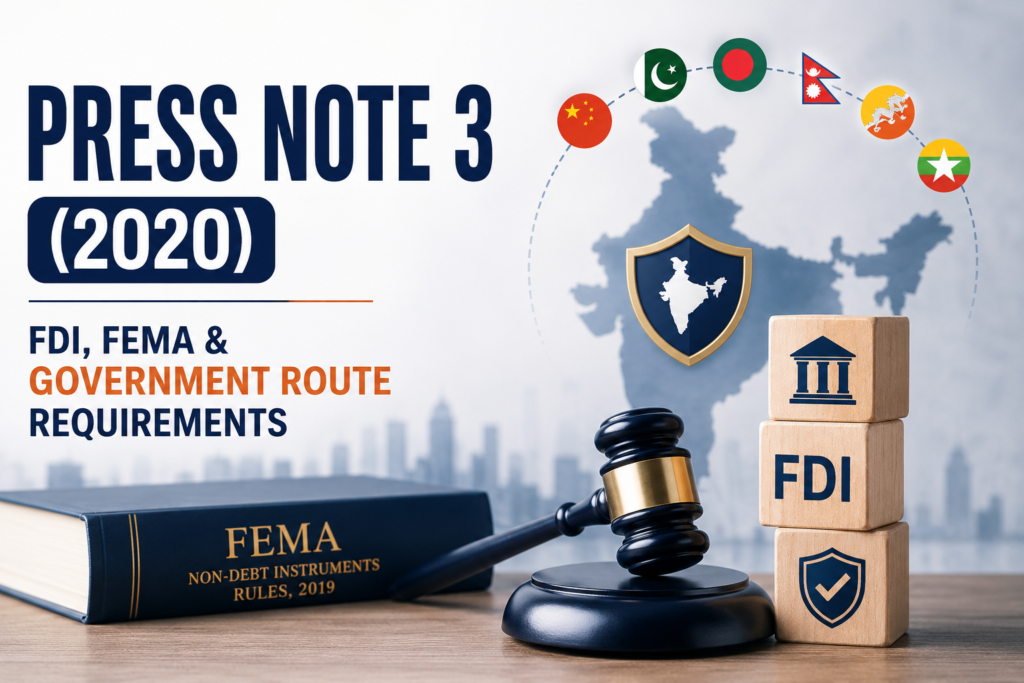
The countries sharing a land border with India for purposes of the FDI framework are:
- China
- Pakistan
- Bangladesh
- Nepal
- Myanmar
- Bhutan
- Afghanistan
Pakistan has additional restrictions under the FDI policy. A citizen of Pakistan or an entity incorporated in Pakistan can invest only under the Government route in permitted sectors, subject to the specific sectoral restrictions applicable to Pakistan.
Press Note 3 and FEMA: How Are the Rules Implemented?
Press Note 3 was a DPIIT policy measure. To give the policy statutory effect under foreign-exchange law, corresponding amendments were made to the FEMA Non-Debt Instruments Rules.
The framework therefore needs to be read together with:
- Press Note 3 (2020 Series)
- Consolidated FDI Policy
- FEMA (Non-Debt Instruments) Rules, 2019, as amended
- Applicable RBI regulations and reporting requirements
- Subsequent amendments, including the 2026 changes
The Reserve Bank of India maintains the regulatory framework governing foreign investment reporting and related FEMA requirements.
For businesses, this means that Press Note 3 compliance is not simply an FDI policy question; it is also a FEMA compliance issue.
What Changed Under the 2026 Press Note 3 Update?
One of the most important developments is Press Note No. 2 (2026 Series) issued by DPIIT on 15 March 2026.
The amendment introduced a more defined approach to beneficial ownership.
Under the revised framework, beneficial ownership is linked to the definition under the Prevention of Money Laundering Act, 2002 (PMLA) and the applicable Prevention of Money-laundering (Maintenance of Records) Rules.
The revised provisions consider whether citizens or entities from a country sharing a land border with India:
- Hold rights or entitlements above the applicable thresholds in the foreign investor;
- Have the ability to exercise control over the investor; or
- Have the ability to exercise ultimate effective control over the Indian investee entity.
The 2026 framework also introduced a reporting requirement for certain investments involving direct or indirect ownership from land-border countries where prior Government approval is not required.
The corresponding FEMA amendment became effective on 2 May 2026, bringing the revised framework into operation.
Why This 2026 Update Matters
The change is significant because companies can no longer rely on a simple “country of incorporation” test.
For example, a foreign investment vehicle incorporated in a third country may still require detailed beneficial-ownership and control analysis if persons or entities connected with a land-border country have relevant ownership or control rights.
At the same time, the revised framework provides more clarity for certain minority investments that do not cross the applicable thresholds and do not involve control or ultimate effective control.
When Is Prior Government Approval Required?
A Press Note 3 assessment should be carried out before the transaction is completed.
Government approval can become relevant in situations such as:
1. Direct investment from a land-border country
If the foreign investor itself is an entity of a country sharing a land border with India, the investment falls under the Government route, subject to the applicable FDI policy.
2. Beneficial ownership from a land-border country
An investor incorporated in a third country may still require Government approval if the beneficial ownership and control criteria under the current rules are triggered.
3. Transfer of existing FDI
A transfer of ownership, whether direct or indirect, can require prior Government approval if the resulting beneficial ownership falls within the restricted category.
4. Downstream investment
Press Note 3 considerations can also become relevant in downstream investment structures.
An Indian entity receiving foreign investment may make downstream investments only after considering the applicable foreign-investment rules, ownership/control position, sectoral conditions, entry route and Press Note 3 implications.
Downstream investments are treated as indirect foreign investment and are subject to applicable entry-route, sectoral-cap, pricing and other FEMA conditions.
Why Beneficial Ownership Analysis Is Important
Beneficial ownership is often the most complicated part of a Press Note 3 FDI assessment.
A company may have a foreign investor incorporated in Singapore, the UAE, the United States, Europe or another jurisdiction. However, the investor’s corporate structure may contain multiple shareholders, investment funds, holding companies or entities across different countries.
Therefore, checking only the immediate shareholder may produce an incomplete compliance assessment.
A proper review may involve:
- Investor incorporation documents
- Shareholding structure
- Ultimate beneficial ownership
- Voting rights
- Control rights
- Shareholder agreements
- Investment agreements
- Board and management rights
- Intermediate holding companies
- Downstream ownership
- Ultimate effective control
The 2026 framework specifically links beneficial ownership to PMLA-based criteria and also considers control and ultimate effective control.
Press Note 3 and Automatic Route FDI
One of the biggest mistakes businesses make is assuming:
“Our sector permits 100% FDI under the automatic route, so no Government approval is required.”
This is not necessarily correct.
The automatic route applies subject to the overall FDI policy and applicable conditions. Press Note 3 operates as an additional country/beneficial-ownership filter.
Therefore, a transaction may be in a sector where FDI is normally permitted under the automatic route but still require Government approval because of the investor’s nationality, incorporation or applicable beneficial-ownership/control position.
DPIIT’s FDI framework confirms that Government-route conditions can apply in addition to sector-specific rules.
How to Check Press Note 3 Applicability Before an FDI Transaction
Indian companies and foreign investors should complete a structured review before signing or closing an investment.
Step 1: Identify the foreign investor
Check:
- Country of incorporation
- Legal status
- Registered ownership
- Ultimate shareholders
Step 2: Map beneficial ownership
Prepare an ownership chart showing all relevant entities and individuals up to the ultimate beneficial owners.
Step 3: Check land-border connections
Identify whether any relevant shareholder, beneficial owner or controlling entity is connected with a country sharing a land border with India.
Step 4: Assess ownership and control
Do not look only at percentage ownership.
Review:
- Voting rights
- Control rights
- Special rights
- Board rights
- Agreements
- Ability to exercise ultimate effective control
Step 5: Check the sector
Confirm:
- Sectoral cap
- Automatic or Government route
- Sector-specific conditions
- Prohibited activities
- Security-clearance requirements, where applicable
Step 6: Determine the approval requirement
If the transaction falls within the Government route, obtain the required approval before completing the investment or relevant transfer.
Step 7: Complete FEMA reporting
After the transaction, ensure that applicable FEMA/RBI reporting is completed within the prescribed timelines.
How Is Government Approval for FDI Filed?
Government-route FDI proposals are filed through the National Single Window System (NSWS). The Foreign Investment Facilitation Portal was integrated with NSWS in August 2022.
DPIIT states that FDI proposals requiring Government approval are filed through the NSWS and processed by the concerned administrative ministry or department according to the applicable procedure.
The exact documentation depends on the transaction, sector, investor structure and nature of the proposal.
Typical documentation may include:
- Investor details
- Shareholding and ownership structure
- Beneficial ownership information
- Proposed investment details
- Corporate documents
- Transaction documents
- Financial information
- Business plan
- Sector-specific information
- Security-related information, where applicable
The application should be prepared carefully because the regulatory authorities may examine the ownership structure, source of investment and proposed transaction in detail.
What Happens If Press Note 3 Requirements Are Ignored?
Completing an FDI transaction without obtaining required Government approval can create a FEMA compliance issue.
Depending on the circumstances, regulatory consequences may include:
- FEMA adjudication proceedings
- Penalties under FEMA
- RBI compounding proceedings where applicable
- Regulatory investigation
- Directions relating to the investment
- Delays in subsequent transfers or restructuring
- Difficulties with future fundraising or transactions
Under Section 13 of FEMA, contraventions can attract significant monetary penalties.
The commercial impact can also extend beyond the penalty itself. A FEMA issue may complicate future fundraising, share transfers, due diligence, banking relationships and corporate transactions.
For this reason, Press Note 3 compliance should be assessed before the transaction is signed or completed, rather than treated as a post-closing formality.
Common Press Note 3 Compliance Mistakes
Mistake 1: Checking only the investor’s country
A third-country investment vehicle does not automatically eliminate the need for beneficial-ownership analysis.
Mistake 2: Ignoring control rights
Ownership percentage alone may not tell the full story. Control and ultimate effective control can also be relevant under the current framework.
Mistake 3: Reviewing only fresh investments
Secondary transfers and changes in beneficial ownership can also trigger Government approval requirements.
Mistake 4: Assuming automatic route means no scrutiny
Sectoral automatic-route eligibility does not override applicable Press Note 3 restrictions.
Mistake 5: Treating FEMA reporting as an afterthought
Approval, reporting and documentation are separate compliance considerations and should be planned together.
Mistake 6: Using outdated 2020 guidance
The original Press Note 3 remains the foundation of the framework, but the beneficial-ownership provisions were materially revised in 2026.
Businesses should therefore use the current FEMA and FDI framework, not rely solely on articles written immediately after the 2020 notification.
Press Note 3 Compliance Checklist for Indian Companies
Before accepting foreign investment, companies should maintain a documented checklist covering:
- Foreign investor’s country of incorporation
- Complete ownership structure
- Ultimate beneficial owners
- Land-border-country connections
- Ownership thresholds
- Voting and control rights
- Ultimate effective control
- Sectoral FDI cap
- Automatic/Government route
- Press Note 3 applicability
- Government approval, where required
- FEMA reporting requirements
- Transaction documentation
- Beneficial-ownership records
- Ongoing compliance review
Maintaining this documentation can help the company demonstrate how its Press Note 3 conclusion was reached if the transaction is later reviewed by regulators, auditors, investors or other stakeholders.
Why Businesses Need an FDI and FEMA Consultant
Press Note 3 compliance can become complicated when an investment involves multiple jurisdictions, holding companies, investment funds or layered ownership structures.
An experienced FDI consultant or FEMA consultant can help businesses assess:
- FDI eligibility
- Automatic versus Government route
- Press Note 3 applicability
- Beneficial ownership
- Investor KYC
- Ownership and control structures
- Downstream investments
- Government approval requirements
- FEMA reporting
- Transaction documentation
- Ongoing compliance
At FEMABIDE Advisorz, the focus is on helping Indian businesses and foreign investors understand and manage FDI and FEMA requirements before regulatory issues become transaction problems.
From beneficial-ownership analysis to Government-route applications and FEMA compliance support, professional FEMA advisory can help businesses approach cross-border investment transactions with greater regulatory clarity.
Frequently Asked Questions About Press Note 3
1. What is Press Note 3 (2020)?
Press Note 3 (2020 Series) is a DPIIT measure introduced on 17 April 2020 that changed India’s FDI policy for investments connected with countries sharing a land border with India. It introduced Government-route requirements for specified investments and beneficial-ownership situations.
2. Which countries are covered under Press Note 3?
The land-border countries are China, Pakistan, Bangladesh, Nepal, Myanmar, Bhutan and Afghanistan.
3. Does Press Note 3 apply only to Chinese investment?
No. The framework applies to the countries sharing a land border with India, not only China.
4. Does an investment from Singapore automatically avoid Press Note 3?
No. The investor’s country of incorporation is only one part of the analysis. Beneficial ownership, ownership rights, control and ultimate effective control may also need to be examined.
5. Does every investment involving a Chinese shareholder require Government approval?
Not necessarily under the current 2026 framework. The revised rules introduce specific beneficial-ownership criteria and consider applicable thresholds, control and ultimate effective control. Certain investments that do not require prior approval may still be subject to reporting requirements.
6. Does Press Note 3 apply to existing investments?
Yes. Changes in ownership of existing or future FDI can require prior Government approval if the transaction results in beneficial ownership falling within the applicable restriction.
7. Can Press Note 3 affect downstream investment?
Yes. Downstream investment is subject to the applicable FDI entry route, sectoral caps, pricing and other conditions. The Press Note 3/land-border framework must also be considered where the relevant ownership or control structure triggers the restriction.
8. Where is Government-route FDI approval filed?
FDI proposals requiring Government approval are filed through the National Single Window System (NSWS), which incorporates the Foreign Investment Facilitation Portal.
9. Is Press Note 3 still relevant in 2026?
Yes. Press Note 3 remains the foundation of the land-border FDI framework, but its beneficial-ownership provisions were revised through Press Note No. 2 (2026 Series) and the corresponding FEMA amendment that took effect on 2 May 2026.
10. Should a company take professional advice before accepting restricted-country FDI?
Yes. Where ownership structures are complex, obtaining an FDI/FEMA review before signing or closing the transaction can help identify Government-route requirements, beneficial-ownership issues and FEMA reporting obligations early.
Conclusion: Press Note 3 Is an Important FDI Compliance Check
Press Note 3 began as a COVID-era measure aimed at preventing opportunistic acquisitions of Indian companies. However, the framework has continued to play an important role in India’s FDI approval regime.
The 2026 update makes beneficial-ownership analysis more structured by introducing defined criteria based on ownership thresholds, control and ultimate effective control, while also creating reporting requirements for certain investments that do not require prior approval.
For Indian companies receiving foreign investment, the key lesson is simple: do not assess FDI eligibility only by looking at the immediate investor or the sectoral cap.
Review the complete ownership chain, beneficial ownership, control, sectoral conditions, Government-route requirements and FEMA reporting obligations before proceeding.
If your business is planning foreign investment, a secondary share transfer, downstream investment or a transaction involving a land-border country, professional FDI consultant and FEMA advisory support can help you assess the regulatory position before the transaction becomes a compliance problem.
FEMABIDE Advisorz provides FDI, FEMA and Government-route advisory support for businesses and investors navigating India’s foreign investment regulations.
Disclaimer: This article is for general informational purposes only and should not be treated as legal, financial or regulatory advice. FDI and FEMA requirements can vary depending on the investor, sector, transaction structure and applicable regulations. Obtain transaction-specific professional advice before proceeding.