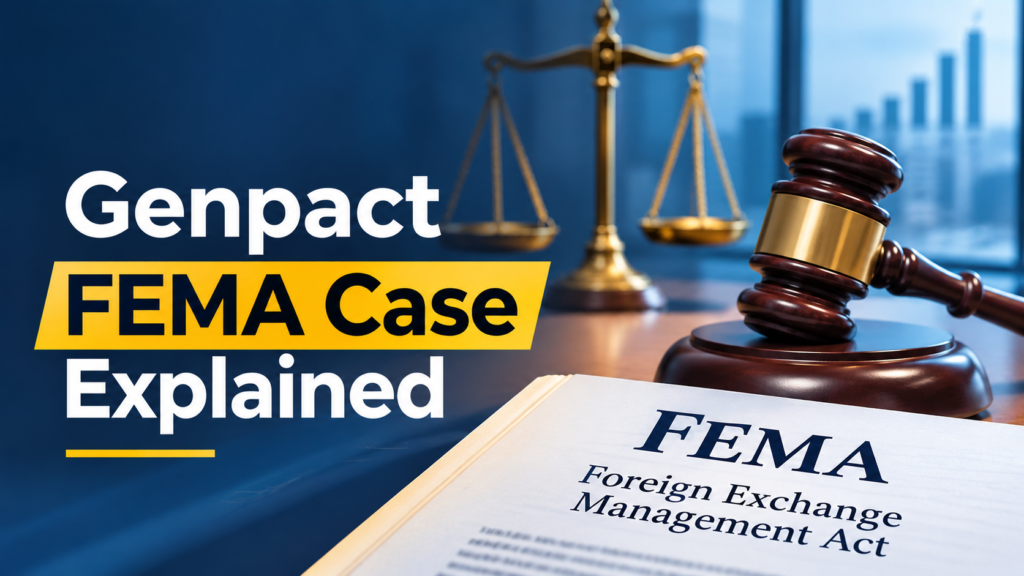
On paper, every step looked textbook. Foreign borrowings. Non-convertible debentures (NCDs) subscribed through the foreign portfolio investor (FPI) route. Foreign direct investment (FDI) equity. A clean share acquisition. Yet years later, the same structure became the basis for an Enforcement Directorate (ED) seizure of a Gurgaon property under Section 37A of the Foreign Exchange Management Act (FEMA).
That is the heart of the Genpact FEMA case, decided by the Karnataka High Court in September 2026. For any business running cross-border structures, it is one of the most important FEMA rulings in recent times. This article explains what happened, what the Court decided and did not decide, and what companies should do now.
Note: this is an analysis of a reported ruling for general information. The ultimate question of whether FEMA was contravened is yet to be decided by the competent authority.
The Background: A Restructuring Meant to Simplify
Genpact set out to rationalise its India footprint and bring its India operations under a single vehicle, Empower India. To get there, the group used a combination of instruments commonly seen in cross-border deals:
- Foreign borrowings
- NCDs issued to an overseas entity registered as an FPI
- FDI equity
- A share acquisition to consolidate the Indian business
As reported, the funds were routed through group entities in jurisdictions such as Bermuda and Luxembourg and ultimately used to repay the original lender, with Indian reserves playing a part in servicing the arrangement. The ED viewed the movement of roughly Rs 7,800 crore as round-tripping, while Genpact maintained that the individual steps were permitted and had been reviewed by other regulators and authorities.
What Is Section 37A of FEMA?
Section 37A empowers an authorised officer to seize, in India, the value equivalent of foreign exchange, foreign securities or immovable property held outside India where there is “reason to believe” that they are held in contravention of Section 4 of FEMA.
Section 4 is the provision that restricts a person resident in India from acquiring, holding, owning, possessing or transferring foreign exchange, foreign security or immovable property outside India, except as permitted. It is a short provision with a very wide reach.
Seizure under Section 37A is not a final finding of guilt. It is a protective step, and the merits are decided later through the statutory process.
What the Karnataka High Court Decided
1. Section 37A cannot be applied retrospectively
Genpact argued that its key transactions were completed in early 2015, while Section 37A came into force on 9 September 2015. The Court accepted the principle: Section 37A cannot be used against transactions completed before that date merely because their consequences continued afterwards.
2. But the “connected arrangement” kept the ED’s door open
The Court then looked at what happened after the provision came into force. The NCDs were serviced and repaid between 2018 and 2023. Viewing the arrangement as a connected scheme, the Court held that the ED had enough material to form a “reason to believe” that Section 4 may have been contravened, and that was sufficient to sustain the seizure at this stage.
In simple terms: old legs of a structure may be protected, but later payments tied to the same structure can keep it within FEMA’s reach.
3. Other approvals did not close the FEMA question
Genpact relied on earlier proceedings before tax authorities, the RBI and SEBI. The Court held that these did not prevent the ED from examining the arrangement under FEMA. The Court also noted that the NCDs being denominated in Indian rupees, and the overseas investor being an FPI, did not by themselves settle the Section 4 question.
4. Round-tripping turns on substance, not just Indian origin
Genpact argued that round-tripping requires money to first leave India and then come back as foreign investment, and that here the money originated abroad. As reported, the Court did not accept such a rigid reading. The real test is whether funds took a circuitous route and ultimately returned to, or came under the control of, the entity they came from.
5. A pending investigation alone cannot justify refusing an NOC
The case also involved an application for a No Objection Certificate for a proposed overseas investment. The Court affirmed an important protection for businesses: a pending ED investigation, by itself, cannot justify refusing an NOC. Any refusal needs relevant, rational and disclosed reasons with a real connection to the proposed investment.
What the Court did not decide
The Court did not finally hold that Genpact violated FEMA, did not quantify any penalty, and left the ultimate question to the competent authority and the statutory process that follows.
Key Lessons for Businesses
1. Substance over form
Regulators will test the whole connected arrangement, not isolated steps. Every leg needs a clear commercial rationale and must fit within a specific FEMA permission.
2. Due diligence must go beyond current structures
Legacy structures that generate ongoing payments, such as interest, redemption or royalties, can become FEMA risks. Diligence should trace end-to-end fund flows for every cross-border step, not just the latest cap table.
3. Tax, FPI and transfer pricing compliance is not FEMA immunity
Being compliant with income tax, SEBI’s FPI rules or transfer pricing does not automatically protect a structure from a Section 4 challenge if the overall effect is unpermitted foreign exposure.
4. Debt push-down and leveraged structures are high-risk
Using Indian cash flows or reserves to service group-level foreign debt, or structures that resemble indirect offshore borrowing repaid from India, will invite heightened scrutiny.
5. Consider ring-fencing early
Where legacy cross-border exposures exist, evaluate whether operating assets can be separated from high-risk legacy assets or entities, so that enforcement action does not disrupt the business.
6. Prepare for NOC and approval stages
If you plan an overseas investment, assume that unresolved questions about past structures may surface. Keep documentation ready that explains each step and its legal basis.
A Practical FEMA Health Check for Cross-Border Groups
- Map every cross-border instrument, payment and counterparty, including legacy ones.
- Identify ongoing payments that trace back to older structures.
- Document the commercial rationale and the FEMA permission for each step.
- Check whether Indian cash flows are servicing foreign obligations in an unpermitted way.
- Review pending or planned approvals, such as NOCs, against the history of the group.
- Take advice early if you spot a gap. Voluntary corrective steps, including compounding where appropriate, are generally easier than defending an enforcement action.
Frequently Asked Questions
What is the Genpact FEMA case about?
It concerns the ED’s seizure of a Gurgaon property under Section 37A of FEMA in connection with a cross-border restructuring, which the ED alleges involved round-tripping. The Karnataka High Court declined to quash the seizure at this stage.
Did the Court find Genpact guilty of a FEMA violation?
No. The Court held that there was enough material for the ED to have “reason to believe” a Section 4 contravention may have occurred. The final determination is for the competent authority.
Can Section 37A be applied to old transactions?
Not to transactions completed before 9 September 2015. However, later payments connected with the same arrangement can be examined.
What is round-tripping under FEMA?
Broadly, it is a circuitous movement of funds that ends up with the money returning to, or being controlled by, the entity it came from, in a way that may not be permitted under FEMA. The substance of the movement matters.
Does approval from the RBI, SEBI or tax authorities protect a structure from FEMA action?
Not automatically. The ruling shows that approvals for individual steps do not necessarily immunise the whole arrangement from FEMA scrutiny.
Can the ED refuse an NOC just because an investigation is pending?
No. A refusal must rest on relevant, rational and disclosed reasons connected to the proposed investment.
Speak to a FEMA Consultant Before Scrutiny Begins
If your group has legacy cross-border structures, is planning an acquisition or overseas investment, or has received an ED or RBI notice, early advice can make the difference. Book a Consultation with Femabide Advisorz at femabide.com or call 99333 85556.
Disclaimer: This article is for general information and is not legal advice. It is based on publicly reported details of the ruling. Please take professional advice based on the facts of your transaction.