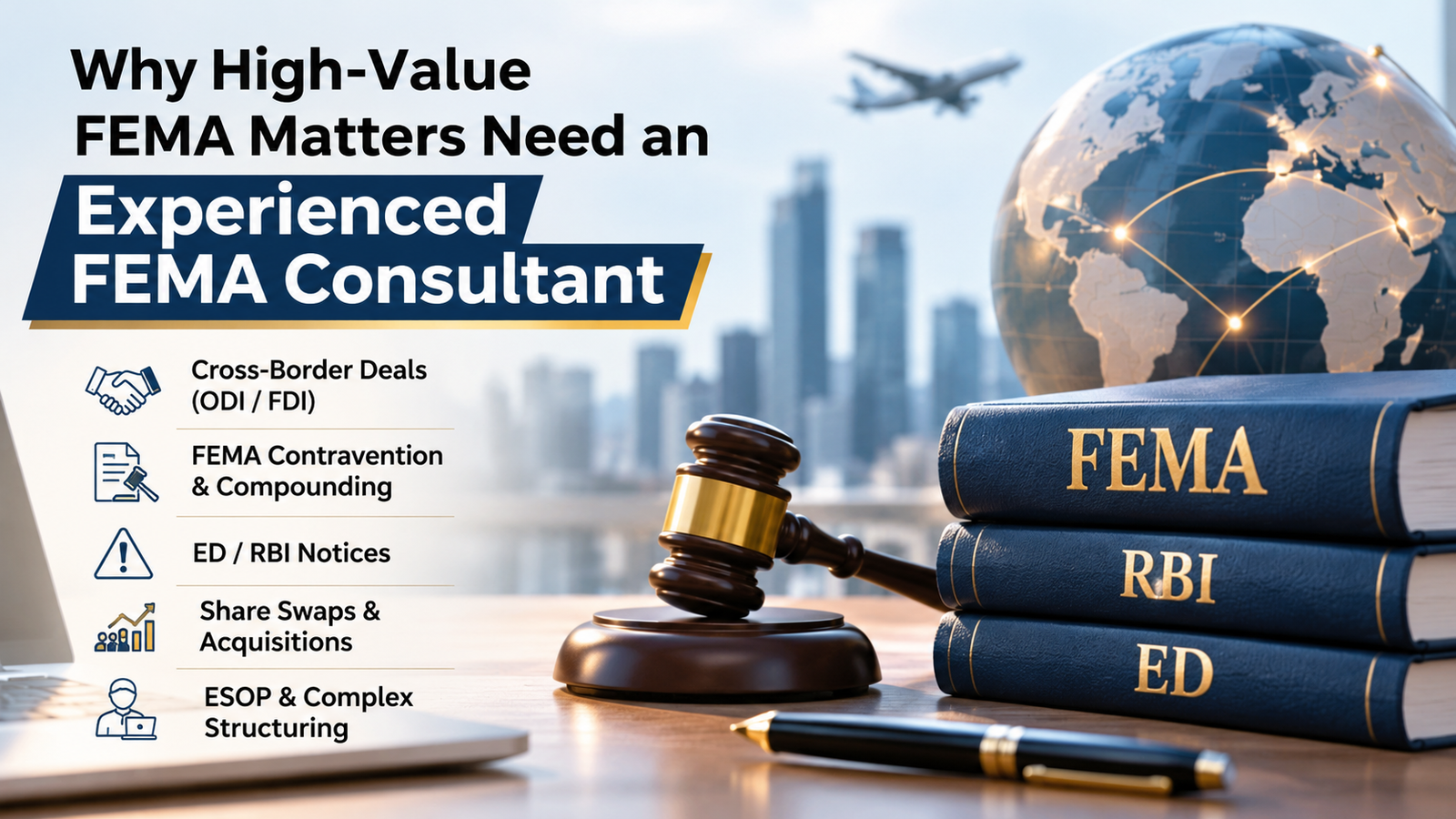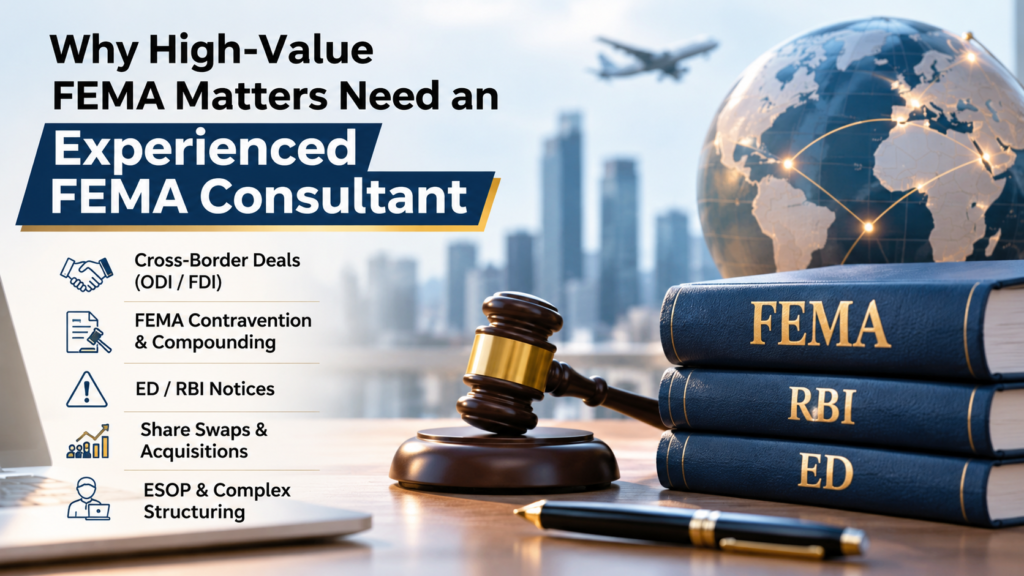
Most FEMA work is routine: a filing here, a remittance there. But some matters are different. A cross-border acquisition, a share swap, a contravention found years after the transaction, or a notice from the Enforcement Directorate (ED) or the Reserve Bank of India (RBI) can put your business, your capital and your reputation on the line.
In these situations, the quality of advice decides the outcome. This article explains the kinds of matters that count as high-stakes under the Foreign Exchange Management Act (FEMA), where things typically go wrong, and what to look for in a FEMA consultant for high-value transactions.
What Makes a FEMA Matter High-Stakes?
A matter becomes high-stakes when one or more of these are true:
- The amounts are large, so even a technical error carries serious financial exposure.
- The structure is complex, with multiple jurisdictions, entities or instruments involved.
- A regulator is already involved, through a show-cause notice, summons or query from the ED or RBI.
- Reputation is at risk, because the matter affects investors, lenders, partners or a planned exit.
- The timeline is tight, such as a deal closing date or a hearing.
Key Types of High-Value FEMA Matters
1. FEMA Contravention and Compounding
A FEMA contravention can arise from late reporting, incorrect pricing, non-compliant remittances, or missed approvals. Contraventions can carry penalties under the Act, and a common route to resolve many of them is compounding, where the contravention is voluntarily admitted and resolved before the RBI on payment of a compounding amount.
Compounding is not just a form to file. The application needs a precise account of facts, a clear timeline, correct quantification and a credible explanation of how the issue arose and what has been done to fix it. A weak application can lead to delays, queries or a larger compounding amount.
2. ED and RBI Notices
Receiving a notice can be alarming. The first response often shapes everything that follows. A good FEMA consultant helps you understand what the notice alleges, what documents to preserve and produce, how to frame the reply, and whether compounding or adjudication is the better path.
The common mistakes are replying in a hurry, giving inconsistent explanations across documents, and ignoring deadlines.
3. ODI and FDI Structuring
Outbound investment (ODI) and foreign direct investment (FDI) both come with sectoral conditions, pricing guidelines, reporting requirements and timelines. Structuring a deal correctly at the start is far cheaper than fixing it later. Key questions include the route (automatic or approval), eligible instruments, valuation, and who files what and when.
4. Share Swaps and Acquisitions
A share swap lets the consideration be paid in shares instead of cash, which can be attractive in cross-border deals. It also raises questions on valuation, permissibility, approvals and reporting. In acquisitions, due diligence from a FEMA angle matters: past non-compliance in the target can become your problem after closing.
5. Deferred Consideration
When part of the purchase price is paid later, the structure must fit within what FEMA permits. Terms, timing, escrow arrangements and documentation all need to be aligned with the regulations to avoid a contravention hidden inside an otherwise commercial agreement.
6. ESOPs for Cross-Border Teams
Issuing employee stock options to non-resident employees or to employees of group entities abroad has its own conditions, along with reporting obligations. Companies often overlook these until a funding round or an exit forces a compliance review.
7. Downstream Investment
When an Indian company that has foreign investment invests in another Indian entity, it may be treated as indirect foreign investment, which brings sectoral and pricing conditions into play. Getting the classification right is essential.
8. Disinvestment and Exits
Exits, whether by sale of shares, buyback or wind-down of an overseas entity, require compliance with pricing, reporting and repatriation rules. Errors at exit are expensive because the transaction is often at its peak value.
Where High-Stakes FEMA Matters Usually Go Wrong
- Commercial teams close the deal first and ask about FEMA later.
- Valuation and pricing are not documented properly.
- Reporting deadlines are missed because nobody owns them.
- Old contraventions surface during due diligence or a funding round.
- Notices are answered without a strategy.
Every one of these is avoidable with early, experienced advice.
What to Look for in a FEMA Consultant for High-Value Matters
Not every FEMA professional is the right fit for a complex matter. Look for:
- Relevant Experience: A demonstrable track record in the specific type of matter you face, whether compounding, notices, structuring or cross-border deals.
- End-to-End Capability: Support from structuring and documentation to filings, replies and representation.
- Clear Communication: Explanations of risks in plain terms and practical options, not jargon.
- Proactive Approach: Identifying issues before they become contraventions.
- Discretion and Professionalism: Essential when handling sensitive matters.
How Femabide Advisorz Helps
Unlike general consultancy and professional firms that handle FEMA as one of several service areas, Femabide Advisorz focuses exclusively on FEMA and foreign exchange regulations. This dedicated approach enables us to develop specialised knowledge, understand regulatory complexities and provide focused solutions for routine compliance as well as high-value and complex FEMA matters.
Femabide Advisorz is an established FEMA consultancy with a proven track record in complex, high-value matters. We advise on FEMA contraventions and compounding, share swaps, ODI and FDI structuring, acquisitions, deferred consideration, ESOPs, downstream investment and disinvestment, and we support clients facing ED or RBI notices.
Our approach is simple: understand the facts, map the exposure, recommend the safest workable path, and execute with precision.
Frequently Asked Questions
1. What is FEMA compounding?
Compounding is a process through which a person who has contravened FEMA can voluntarily admit the contravention and settle it before the RBI by paying a compounding amount, as an alternative to adjudication.
2. What should I do first if I receive an ED or RBI notice?
Do not ignore it and do not reply in a hurry. Note the deadline, gather the relevant documents and consult an experienced FEMA consultant before responding.
3. Do I need FEMA advice before a cross-border acquisition?
Yes. FEMA review at the structuring and due diligence stage helps avoid pricing, approval and reporting issues, and identifies inherited contraventions.
4. Can ESOPs for foreign employees create FEMA issues?
They can, if conditions and reporting requirements are not followed. Review them before issuing and again before any funding round or exit.
Speak to a FEMA Consultant Before the Stakes Rise
If you are planning a high-value transaction or dealing with a FEMA contravention or notice, speak to us early.
Book a Consultation: femabide.com
Call: 99333 85556
Disclaimer: This article is for general information and is not legal advice. Please take professional advice based on the facts of your transaction.