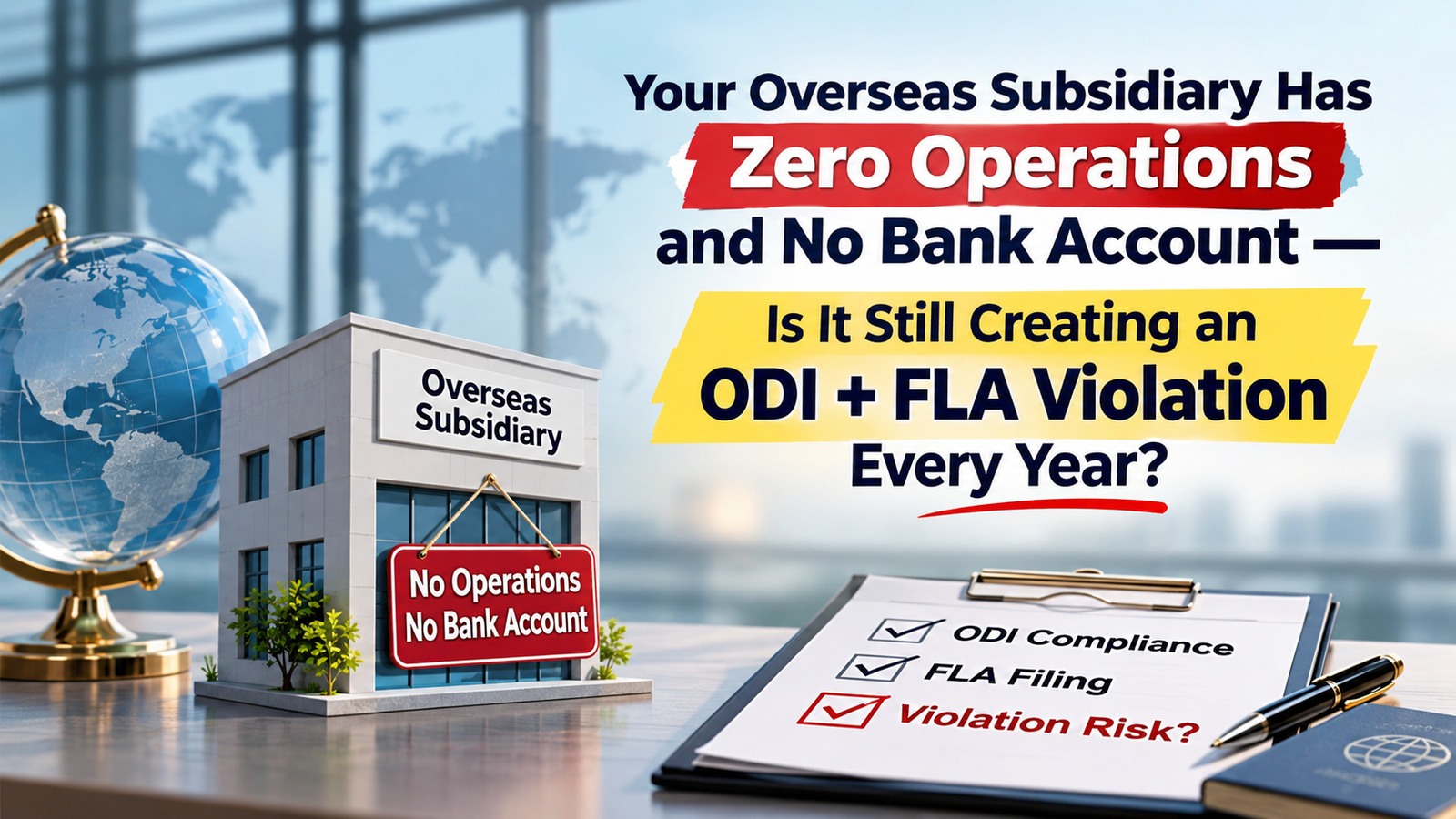
If your company set up a subsidiary abroad two or three years ago and it never really took off, no revenue, no employees, no bank account, you might assume there is nothing left to report. No transactions means no compliance, right?
That assumption is one of the most common and most expensive mistakes Indian promoters make under FEMA. A dormant overseas subsidiary does not go quiet on RBI’s radar. It stays open on your books as an outstanding Overseas Direct Investment, and that single fact keeps two compliance obligations alive every single year, whether the entity does anything or not.
A Dormant Subsidiary Is Still an “Outstanding Investment” Under FEMA
Under the Foreign Exchange Management (Overseas Investment) Rules, 2022, once you have made a financial commitment to a foreign entity, whether that was share capital, a loan, or a guarantee, that commitment does not disappear just because the entity stopped operating. It remains an outstanding overseas investment on record until you formally close, wind up, or divest it through the proper FEMA route.
This distinction matters because most business owners think in terms of activity. RBI thinks in terms of outstanding exposure. As long as your subsidiary exists on paper and your original investment has not been formally reversed, you are an investor with an outstanding ODI position, and that status alone activates ongoing reporting duties.
The FLA Return Trap: Zero Activity Still Means Mandatory Filing
The Annual Return on Foreign Liabilities and Assets, commonly called the FLA return, is where most dormant-subsidiary cases quietly turn into violations.
The FLA return is a position based filing, not a transaction based one. It applies to any Indian resident entity that has outstanding FDI or ODI as on the end of March, regardless of whether a single rupee moved during the year. Even if your subsidiary has no bank account, no revenue, and no activity to report, you are still required to file the FLA return by July 15 every year, declaring the outstanding investment at its last known or nil value.
Companies that stop filing because “there is nothing to report” are, in RBI’s eyes, simply not filing. Non-filing of the FLA return is treated as a FEMA violation in its own right, and it compounds every year the subsidiary stays open unreported. A Late Submission Fee applies for delayed filing, and the exposure only grows the longer the dormant entity sits unreported year after year.
Why a Bank-Account-Less Subsidiary Raises a Bigger Question: Is It a Shell?
There is a second, more serious layer to this problem. The Overseas Investment Rules require that any investment made outside India be in a foreign entity engaged in a bona fide business activity, meaning an activity that is legally permissible under the laws of both India and the host country. The rules were built around the idea that Indian capital moving abroad should fund real, operating businesses, not paper structures.
A subsidiary with no bank account, no local operations, and no discernible business activity years after incorporation does not just create a filing gap. It starts to look like exactly the kind of entity FEMA’s bona fide business activity requirement was written to screen out. When RBI or the Enforcement Directorate reviews an overseas structure and finds no operational substance behind it, the question stops being “did you file your FLA return” and becomes “why does this entity exist at all.”
This is where dormant subsidiaries move from a compliance oversight into shell company risk territory, a category regulators scrutinise far more aggressively than a simple late filing.
The Section 37A Reality Check
Section 37A of FEMA gives the Enforcement Directorate the power to seize equivalent value in India when foreign exchange has been sent abroad in suspected contravention of the Act, and the case is pending adjudication. It exists specifically to address situations where Indian capital moves overseas into structures that cannot demonstrate legitimate, ongoing business purpose.
A dormant subsidiary with years of unreported FLA returns, no bank account, and no visible operations is precisely the fact pattern that invites this level of scrutiny. It is not just an accounting oversight sitting quietly in a filing cabinet. It is a live compliance gap that grows a year at a time, and the longer it sits unresolved, the harder it becomes to explain away as an innocent lapse.
What This Actually Means for You, Every Year, Automatically
To be direct about the compliance clock that keeps running on a dormant overseas subsidiary:
- FLA return: Due every July 15 for as long as the investment remains outstanding, active business or not.
- Late Submission Fee: Applies from the point the deadline is missed, and accumulates with every missed filing year.
- Bona fide business activity test: A subsidiary with no discernible operations invites scrutiny of whether it should have existed in this form in the first place.
- Section 37A exposure: In the most serious cases, unexplained overseas structures with no operational substance can trigger seizure proceedings pending adjudication.
- Compounding as a way out: Missed FLA filings and dormant-structure issues can generally be regularised through RBI’s compounding mechanism, but only if addressed before enforcement action begins, not after.
The Fix Is Rarely as Complicated as the Fear Suggests
Most dormant-subsidiary cases we review are not fraud. They are simply structures that were set up with good intent, stalled for business reasons, and then fell off the promoter’s radar because nothing seemed to be “happening” that required attention.
The fix usually involves one of three paths: bringing the FLA filings current and documenting the entity’s status honestly, formally winding up or divesting the dormant subsidiary through the proper FEMA route, or demonstrating genuine business activity if the entity is meant to stay operational. What matters is doing this proactively, before RBI’s own data matching flags the gap for you.
Don’t Let a Forgotten Subsidiary Become an Enforcement File
If you have an overseas subsidiary that has gone quiet, no bank account, no recent filings, no clear operational status, the safest move is to get it reviewed now, not after a notice arrives. Femabide Advisorz specialises in exactly this kind of FEMA ODI and FLA compliance review, from filing history reconstruction to compounding applications where needed.
Call 99333 85556 or visit femabide.com to get your overseas subsidiary’s compliance status reviewed before it becomes someone else’s investigation.