An Indian manufacturing exporter completes a shipment, submits the shipping bill, raises the invoice, and eventually receives the full payment. The amount is correct, the currency is correct, and there is no dispute with the overseas buyer.
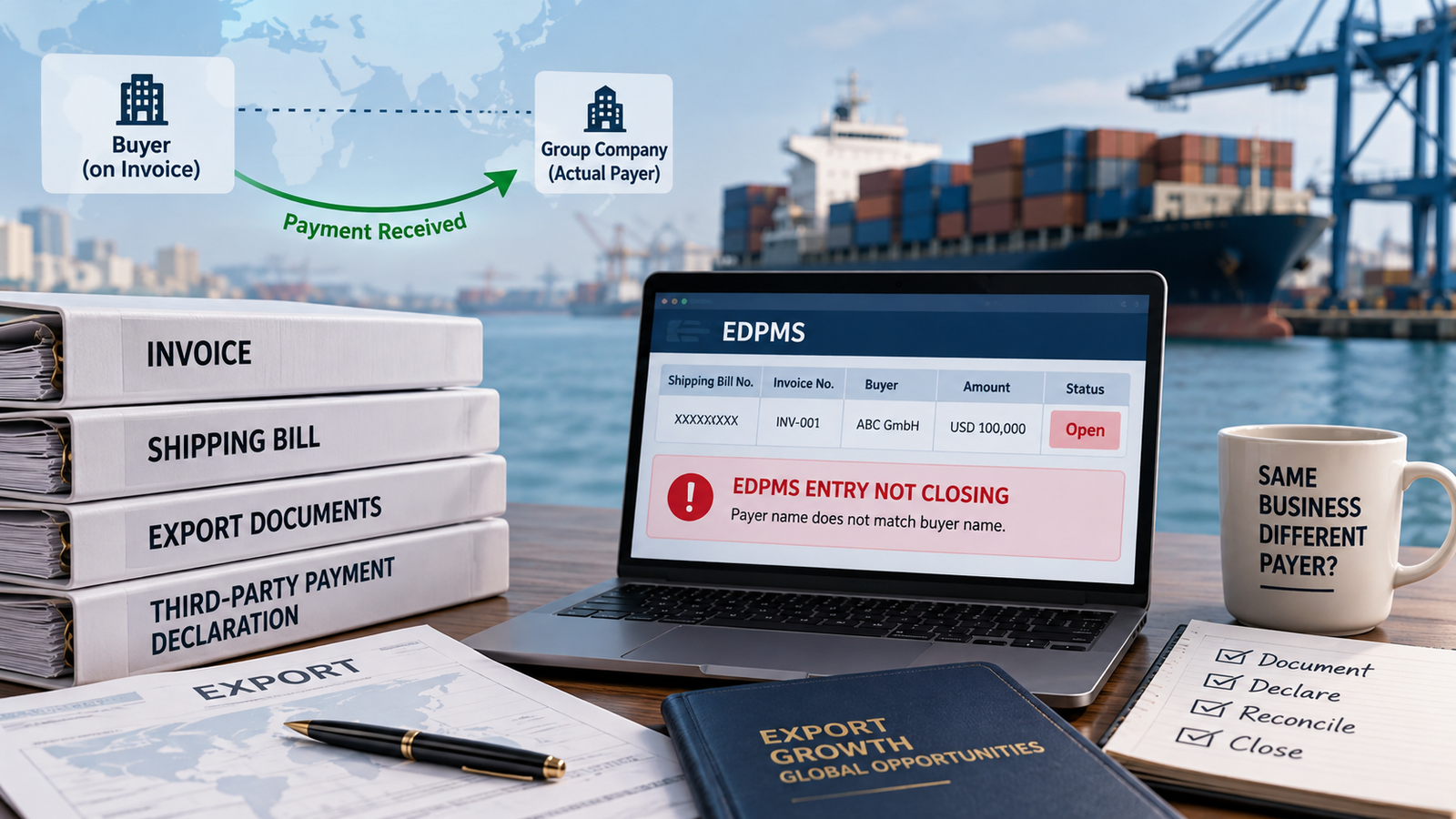
Yet the EDPMS is not closing due to third-party payment.
This situation is becoming increasingly familiar for exporters dealing with multinational customers. The company named on the invoice may be the actual buyer, while the payment comes from its parent company, regional treasury centre, shared service entity, or another group company.
From the exporter’s perspective, this may simply be the buyer’s normal payment process. From the bank’s perspective, however, the payer and buyer are two different entities. That difference needs to be properly documented and reconciled before the export transaction can be closed.
For manufacturing exporters handling regular international shipments, understanding this issue early can prevent repeated bank queries, delayed e-BRC issuance and unnecessary EDPMS backlogs.
Why Is EDPMS Not Closing When Payment Has Been Received?
The Electronic Data Interchange system for export monitoring, commonly referred to as EDPMS, records export transactions and helps authorised dealer banks reconcile export proceeds against the relevant shipping bills.
A typical transaction may look straightforward:
- The Indian manufacturer exports goods to Company A.
- Company A is named as the buyer on the invoice.
- The shipping bill reflects the export transaction.
- Company B, which belongs to the same corporate group, sends the payment.
- The exporter receives the full amount.
The problem arises because the entity making the remittance is not the same entity appearing as the buyer in the export documentation.
This does not automatically mean that the transaction is improper. Third-party export payments can be permitted under the applicable FEMA framework, subject to prescribed conditions and appropriate documentation.
However, the exporter needs to establish the connection between the buyer, the third-party payer and the underlying export transaction.
That is why an EDPMS closure issue often becomes a documentation and reconciliation problem rather than a payment problem.
Why Manufacturing Exporters Commonly Face Third-Party Payment Issues
Large international manufacturing groups frequently centralise their payment operations.
For example, an Indian auto-component manufacturer may sell products to a manufacturing subsidiary in Germany. However, the German subsidiary may not make the payment itself. Instead, the group’s treasury centre in the Netherlands may process payments for suppliers around the world.
A similar structure can occur in:
- Auto components
- Pharmaceuticals and APIs
- Textile and apparel manufacturing
- Engineering goods
- Industrial machinery
- Chemicals
- Electronics
- Packaging products
- Consumer goods manufacturing
The same corporate structure can involve several entities:
Indian exporter → Overseas buyer → Parent company → Treasury/payment centre
The commercial relationship may be perfectly legitimate, but the banking records need to make that relationship clear.
For exporters handling large volumes, failing to document this structure can result in the same buyer-payer mismatch under FEMA appearing repeatedly across multiple shipments.
What Happens When the Buyer and Payer Are Different?
When the payment reaches the exporter’s bank, the bank reviews the remittance and attempts to associate it with the relevant export transaction.
If the remitter is different from the buyer stated in the export documents, the bank may need additional information.
The bank may ask questions such as:
- Why did a different company make the payment?
- What is the relationship between the buyer and the payer?
- Is the payer part of the same corporate group?
- Was third-party payment agreed under the commercial arrangement?
- Can the payment be linked clearly to the relevant invoice and shipping bill?
- Are the required declarations and supporting documents available?
Until these questions are satisfactorily addressed, the export transaction may remain outstanding.
This is one of the main reasons exporters search for solutions to EDPMS not closing even after receiving the complete export proceeds.
FEMA and Third-Party Export Payments
The FEMA framework does not simply require every export payment to originate from the exact legal entity named as the buyer.
RBI regulations and directions provide for receipt of export proceeds from third parties subject to applicable conditions. The exporter’s authorised dealer bank plays an important role in establishing the genuineness of the transaction and ensuring that the payment can be appropriately linked to the export.
This distinction is important.
A payment from a group company should not automatically be treated as an irregular payment merely because its name differs from the buyer on the invoice.
Instead, the exporter should be able to demonstrate:
- Who purchased the goods.
- Who actually made the payment.
- Why the third party made the payment.
- The relationship between the buyer and payer.
- That the payment relates to the specific export transaction.
- That the relevant FEMA and banking requirements have been followed.
Proper documentation makes this explanation much easier.
What Documents Can Help Resolve an EDPMS Closure Issue?
The exact documents required can depend on the transaction and the authorised dealer bank. However, exporters should generally maintain a clear documentary trail.
Important documents may include:
1. Purchase Order or Supply Agreement
The purchase order should identify the overseas buyer and, where possible, explain the agreed payment mechanism.
If payment is expected from a group treasury company, documenting this arrangement in advance can reduce confusion later.
2. Commercial Invoice
The invoice establishes the buyer, transaction value, currency and other commercial details.
3. Shipping Bill
The shipping bill connects the physical export with the customs declaration and corresponding export transaction.
4. Third-Party Payment Declaration
Where applicable, the exporter should provide the required declaration identifying the third-party payer.
5. Proof of Relationship Between Buyer and Payer
This can help establish that the remitting company is a parent company, subsidiary, group company, treasury centre or other related entity.
6. Bank Remittance Details
The exporter should retain the inward remittance information showing the remitter, amount, currency and transaction reference.
The objective is simple: the bank should be able to understand the complete chain from the export transaction to the actual receipt of funds.
What Should Be Mentioned in Export Documentation?
Where a third-party payment arrangement is already known, exporters should avoid waiting until the money arrives to explain it.
The payment structure should be documented as early as commercially practical.
For example, the exporter’s records can clearly establish that:
Buyer: ABC Manufacturing GmbH
Third-Party Payer: ABC Global Treasury BV
Relationship: Group company
Purpose: Payment against invoices issued to ABC Manufacturing GmbH
The exact wording and declaration requirements should be confirmed with the exporter’s authorised dealer bank.
The key point is consistency.
The purchase agreement, invoice, export declaration, remittance details and bank records should tell the same commercial story.
Why an Open EDPMS Entry Should Not Be Ignored
An outstanding EDPMS entry may initially look like a routine banking issue. However, exporters should not allow aged entries to accumulate.
An unresolved export transaction can create additional administrative work when the exporter later needs evidence of export realisation or supporting documentation for other compliance processes.
It can also become more difficult to resolve an old transaction when documents, employees or banking records are no longer readily available.
For exporters with dozens or hundreds of shipments, even a small percentage of unresolved transactions can create a significant backlog.
That is why companies should periodically review their outstanding EDPMS transactions rather than waiting for a bank query.
How e-BRC Can Be Affected
The Electronic Bank Realisation Certificate, or e-BRC, provides evidence relating to realisation of export proceeds.
When an export payment cannot be properly matched with the corresponding export transaction, the exporter may face delays in completing the related banking process.
For businesses that depend on timely export documentation for GST-related processes, incentives or internal compliance, unresolved realisation records can become an unnecessary operational burden.
The solution is usually not to repeatedly submit the same payment details.
Instead, the underlying mismatch needs to be properly explained and reconciled with the AD bank.
A Recurring Group Payment Should Be Treated as a Process, Not an Exception
One of the biggest mistakes exporters make is treating every third-party payment as a completely new problem.
Suppose a multinational customer always pays through the same treasury centre.
Shipment after shipment, the exporter receives payment from the same group entity.
If the exporter explains the arrangement separately every time, the finance team spends unnecessary time answering repetitive queries.
A better approach is to establish the payment structure clearly at the beginning of the commercial relationship.
The exporter can work with the buyer and its AD bank to maintain appropriate documentation explaining:
- The identity of the buyer
- The identity of the regular payer
- Their corporate relationship
- The reason for centralised payment
- The relevant invoices or transactions
- The applicable declarations
This creates a repeatable process for future exports.
How Manufacturing Exporters Can Prevent EDPMS Problems
A practical approach is to review the payment structure before the first shipment.
Step 1: Identify the actual payer
Ask the overseas customer which legal entity will make the payment.
Do not assume that the company named on the purchase order will necessarily be the remitter.
Step 2: Check the buyer-payer relationship
Determine whether the payer is a parent company, subsidiary, treasury centre, shared service centre or another related entity.
Step 3: Document the arrangement
Keep the payment arrangement in the purchase order, agreement, correspondence or other appropriate records.
Step 4: Inform the AD bank
Discuss recurring third-party payment arrangements with the authorised dealer bank before they become a reconciliation problem.
Step 5: Match remittances carefully
When the payment arrives, ensure the finance team can identify the corresponding invoice and shipping bill.
Step 6: Review outstanding EDPMS entries regularly
Do not wait until an old transaction becomes a larger compliance problem.
A monthly or quarterly reconciliation can help exporters identify mismatches early.
What If Your EDPMS Entries Are Already Outstanding?
If your company already has several open entries, start with a transaction-level reconciliation.
Prepare a list showing:
| Export Details | Payment Details |
|---|---|
| Shipping bill number | Remittance reference |
| Shipping bill date | Remittance date |
| Buyer name | Payer name |
| Invoice number | Amount received |
| Invoice value | Currency |
| Outstanding amount | Bank details |
Then identify why each entry remains open.
Some cases may involve a simple documentation gap. Others may require clarification from the overseas buyer or additional information for the AD bank.
The important thing is to resolve the underlying reason rather than repeatedly following up without a structured reconciliation.
Why Professional Review Can Help
Third-party payment arrangements can involve multiple documents, entities and banking records.
For manufacturing exporters with a large export volume, reviewing every outstanding transaction internally can take considerable time.
A professional review can help identify:
- Buyer-payer mismatches
- Missing declarations
- Aged EDPMS entries
- Documentation gaps
- Repeated payment-pattern issues
- Transactions requiring bank clarification
The objective is not simply to close old entries. It is to create a process that reduces the likelihood of the same issue occurring on future shipments.
Conclusion
When the buyer named on an export invoice is different from the company that actually sends the payment, the transaction does not necessarily become invalid. Third-party export payments can be permitted under the applicable FEMA framework, provided the relevant requirements are satisfied.
The challenge arises when the relationship between the buyer and payer is not clearly documented or the payment cannot be easily matched with the export transaction.
If your EDPMS is not closing due to third-party payment, the practical starting point is to identify the payer, establish its relationship with the buyer, collect the relevant documentation and work with your authorised dealer bank to reconcile the payment against the correct export transaction.
For manufacturing exporters that regularly receive payments through group treasury entities, this should be treated as an ongoing process rather than a shipment-by-shipment problem.
Get Your EDPMS and Export Realisation Structure Reviewed
Femabide Advisorz works with manufacturing exporters to review buyer-payer documentation, address aged EDPMS entries and establish appropriate documentation for recurring group-company payment arrangements.
Call: 99333 85556
Website: femabide.com
Frequently Asked Questions
1. Why is my EDPMS not closing even though I have received the full export payment?
An EDPMS entry may remain open when the payment is received from an entity different from the buyer mentioned in the export documents. The authorised dealer bank may require additional documentation to establish the relationship between the buyer and third-party payer and link the remittance to the relevant export transaction.
2. Can an Indian exporter receive payment from a group company?
Third-party export payments can be permitted under the applicable FEMA framework, subject to prescribed conditions. Exporters should ensure that the third-party payment arrangement is properly documented and that the payment is received through the permitted banking channels.
3. What documents are needed to resolve a buyer-payer mismatch?
Depending on the transaction and the AD bank’s requirements, documents may include the purchase order or agreement, commercial invoice, shipping bill, third-party payment declaration, remittance details and evidence establishing the relationship between the buyer and payer.
4. Can a buyer-payer mismatch delay e-BRC?
Yes. If the inward remittance cannot be properly matched or linked with the relevant export transaction, the related EDPMS entry may remain outstanding and the e-BRC process may be delayed. The exporter should coordinate with the AD bank to resolve the mismatch.
5. How can exporters prevent recurring group-company payment issues?
Exporters should identify the actual paying entity before shipments begin, document the payment arrangement, maintain supporting records and discuss recurring third-party payment structures with their AD bank. Regular EDPMS reconciliation can also help identify and resolve mismatches before they become aged entries.