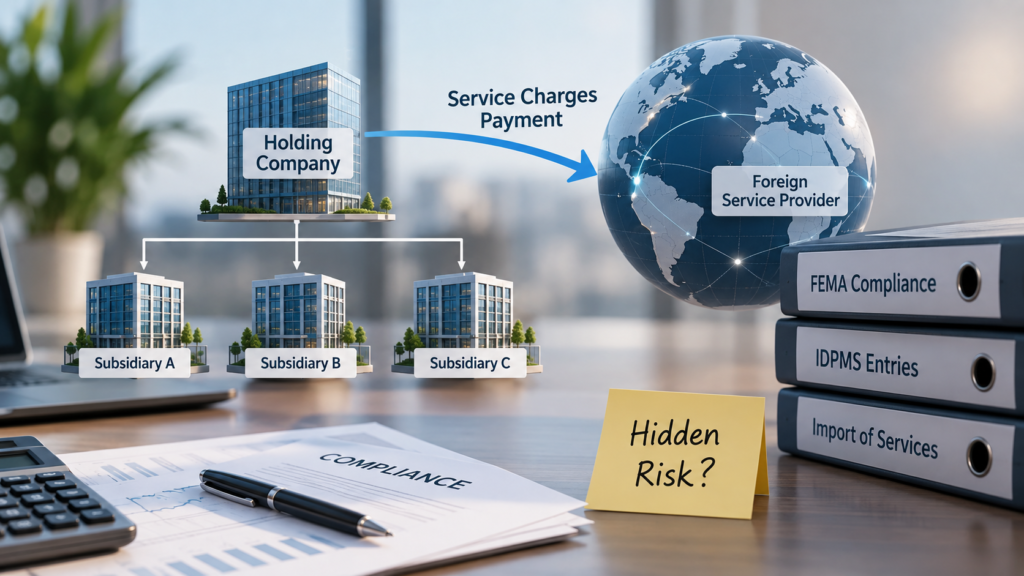
When a holding company pays a foreign vendor on behalf of a subsidiary or another group entity, the arrangement may appear to be nothing more than a convenient internal payment mechanism. However, under India’s foreign exchange regulations, inter-company service charges FEMA compliance can become complicated when the entity making the payment is different from the entity that actually receives or uses the service.
This is particularly important for groups that routinely make payments for international software subscriptions, consulting services, management fees, cloud services, professional services, marketing, technical support, or other imported services.
If the payment structure and supporting documents do not clearly establish the relationship between the payer, importer of the service, and foreign beneficiary, the transaction may create issues involving third party payment FEMA requirements, import evidence and open IDPMS entries.
For companies with years of recurring overseas service payments, these unresolved entries can eventually become a significant FEMA compliance concern.
What Are Inter-Company Service Charges Under FEMA?
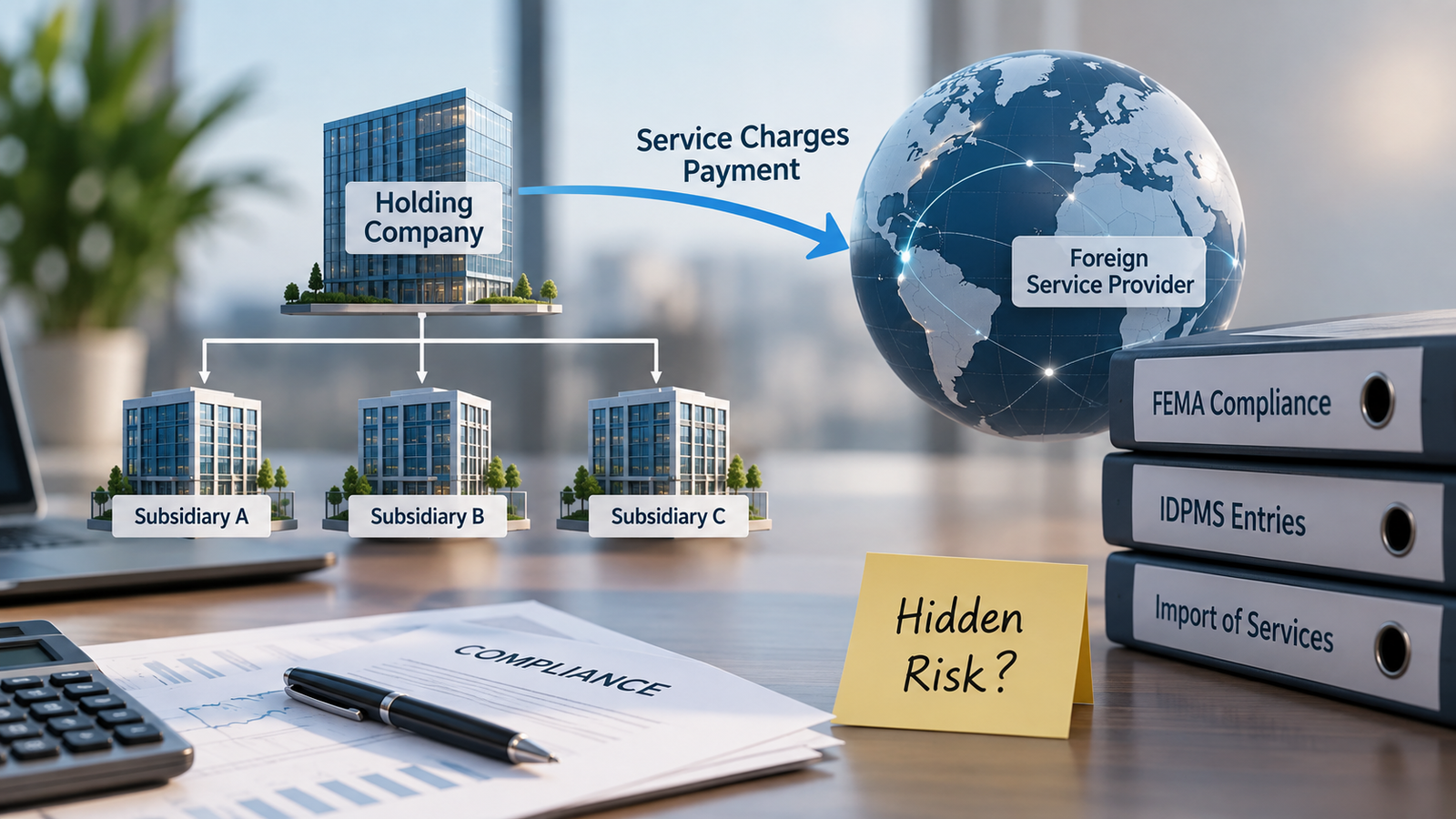
Inter-company service charges generally arise when one group company pays or bears expenses relating to services used by another group entity and subsequently recovers or allocates those costs internally.
For example:
- An Indian holding company pays a foreign software provider.
- The software is primarily used by an Indian subsidiary.
- The holding company subsequently allocates the expense to the subsidiary.
- The foreign invoice may identify the subsidiary as the service recipient while the holding company actually makes the outward remittance.
From an accounting perspective, this may be recorded as an inter-company recharge.
From a FEMA perspective, however, the identity of the importer, payer and beneficiary of the service becomes important.
This is why companies should not treat inter-company service charges as merely an accounting or transfer-pricing exercise.
Why Can a Holding Company Paying on Behalf of a Group Entity Become a FEMA Issue?
The key issue is whether the payment qualifies as a permissible third-party payment and whether the transaction is adequately documented.
A foreign service provider may issue an invoice to one group company while the payment is made by another. If the supporting agreement, invoice, banking documentation and internal records do not explain why the holding company is making the payment, the AD bank may have difficulty establishing the nature of the transaction.
This can create questions around:
- Who actually imported the service?
- Who was contractually liable to pay?
- Why did another group company make the remittance?
- What relationship exists between the payer and service recipient?
- Was the third-party payment arrangement disclosed to the AD bank?
- What evidence establishes that the service was actually received?
- Which entity should provide the supporting import documentation?
Therefore, third party payment FEMA compliance should be considered before the remittance is made not only when an old entry is being investigated.
What Are Open IDPMS Entries?
Open IDPMS entries generally refer to import-related transactions that remain unresolved or unmatched in the banking system because the required evidence or reconciliation has not been completed.
For goods, import documentation such as the Bill of Entry provides an established evidence trail.
Services are different.
There is no customs Bill of Entry for an imported service. Consequently, companies and their Authorised Dealer banks need appropriate documentation to establish the underlying transaction and its completion.
When a holding company makes a payment for services used by another group entity, the documentation trail can become fragmented.
For example:
Foreign vendor → invoice to subsidiary → payment by holding company → service used by subsidiary → internal cost allocation
If the bank’s records identify the holding company as the remitter but the supporting evidence sits with the subsidiary, the transaction may remain unresolved unless the records are properly connected.
That is one reason recurring group payments can result in open IDPMS entries.
How Do Open IDPMS Entries Become a FEMA Compliance Risk?
An unresolved entry is not automatically proof of a FEMA contravention. However, prolonged non-reconciliation can create a compliance problem, particularly when combined with deficiencies in the underlying payment structure.
A group company may face greater scrutiny where there is a pattern of:
- Repeated third-party outward remittances
- Missing or inconsistent invoices
- Lack of inter-company agreements
- Inadequate evidence of service receipt
- Unreconciled import-service transactions
- Payments made by an entity different from the service recipient
- Long-standing open entries
- Inadequate communication with the AD bank
The risk increases further when the company cannot reconstruct the commercial rationale for historical payments.
For this reason, businesses should periodically review their import of services compliance rather than waiting for a bank query or regulatory notice.
A Simple Example of the Risk
Consider an Indian holding company with three subsidiaries.
The group uses an overseas enterprise software platform. The foreign vendor raises a monthly invoice for the software services. Instead of each subsidiary paying separately, the holding company makes the payment and later recovers the relevant cost from the subsidiaries.
The arrangement may be commercially sensible.
But suppose:
- The vendor’s invoice identifies Subsidiary A.
- The holding company makes the outward remittance.
- The bank records the holding company as the remitter.
- The service agreement is maintained by Subsidiary A.
- Evidence of service receipt is never submitted by the holding company.
- The inter-company cost allocation is recorded only in the group’s accounting system.
Years later, the bank asks why the import-related transaction remains unresolved.
The company now has to connect documents maintained by multiple entities and explain the original payment arrangement.
This is where a routine group payment can turn into a FEMA contravention group structure issue.
What Documentation Should Be Maintained?
Companies should ideally establish the documentation trail before making recurring third-party payments.
Depending on the nature of the transaction, the file should clearly establish:
1. Inter-Company Agreement
The agreement should explain the commercial relationship between the entities and, where appropriate, the arrangement under which one entity makes payments for another.
2. Foreign Service Agreement
The underlying contract with the overseas service provider should clearly identify the service recipient and relevant payment obligations.
3. Invoice and Payment Records
Invoices should be retained together with outward remittance documentation, bank records and relevant transaction references.
4. Evidence of Service Receipt
The company should maintain appropriate evidence demonstrating that the service was actually received or used.
5. Internal Cost Allocation
The inter-company debit/recharge should be supported by appropriate accounting records and the commercial basis for allocation.
6. AD Bank Correspondence
Where a third-party payment arrangement is involved, relevant correspondence and disclosures to the Authorised Dealer bank should be retained.
The objective is simple: a reviewer should be able to understand the complete transaction without having to reconstruct it from multiple disconnected systems.
Common FEMA Mistakes Made by Group Companies
Several recurring practices can create avoidable compliance problems.
Mistake 1: Treating the Transaction as “Only an Inter-Company Expense”
An internal recharge does not eliminate the FEMA implications of the original cross-border payment.
Mistake 2: Assuming Group Companies Are Automatically Interchangeable
A holding company, subsidiary and sister concern are separate legal entities. Their relationship should be properly documented rather than assumed.
Mistake 3: Ignoring Third-Party Payment Requirements
A payment made by an entity other than the service recipient should be reviewed under the applicable FEMA and RBI framework.
Mistake 4: Waiting Until the Bank Raises a Query
Historical transactions are significantly harder to reconstruct after several years.
Mistake 5: Focusing Only on Accounting Reconciliation
A ledger showing that the subsidiary reimbursed the holding company does not necessarily close the foreign exchange documentation trail with the AD bank.
How Should Companies Review Old Open IDPMS Entries?
A structured historical review can help identify and resolve potential issues before they become more serious.
A practical review can include:
Step 1: Extract outstanding entries
Obtain the company’s outstanding import-related transactions and identify aged or unresolved entries.
Step 2: Categorise the transactions
Separate goods, services, recurring subscriptions, consulting fees, management charges and other categories.
Step 3: Identify the actual service recipient
Determine which group company actually contracted for, received or used the service.
Step 4: Compare the payer and recipient
Where these are different entities, determine whether the third-party payment arrangement was properly documented.
Step 5: Reconstruct the evidence trail
Match invoices, agreements, payment records, service evidence and inter-company accounting entries.
Step 6: Coordinate with the AD bank
Discuss the appropriate documentation and reconciliation process with the Authorised Dealer bank.
Step 7: Assess potential FEMA exposure
Where documentation gaps or potential contraventions exist, obtain appropriate FEMA legal advice on the available regularisation or compounding route.
How Can Companies Prevent Future FEMA Contraventions?
The best solution is to build FEMA compliance into the payment process rather than treating it as an annual cleanup exercise.
Before a recurring overseas service payment is made, the group should establish:
- The correct service recipient
- The entity responsible for payment
- The contractual basis for the payment
- The permissibility and documentation of any third-party payment
- The required evidence of service import
- The process for submitting documents to the AD bank
- A reconciliation mechanism for outstanding entries
A centralised payment model can continue to work, but it needs a corresponding FEMA-compliant documentation trail.
Why a Historical FEMA Review Matters
A company may have been following the same payment process for years without receiving a regulatory objection. That does not necessarily mean the process is fully compliant.
As businesses grow, transaction volumes increase and group structures become more complex. Historical payment arrangements can also become difficult to explain when the employees who originally handled them have moved on.
A proactive review can help identify:
- Aged open IDPMS entries
- Potential third-party payment gaps
- Missing service-import evidence
- Inconsistent invoices
- Incorrect payer/recipient documentation
- Gaps in inter-company agreements
- Repeated compliance weaknesses
The objective is not simply to close an old bank entry. It is to understand the underlying transaction and ensure that future payments are structured correctly.
Conclusion: Inter-Company Payments Need More Than an Accounting Trail
Centralising foreign service payments through a holding company can be commercially efficient, but it should not be treated as a purely internal accounting arrangement.
Where one group company pays a foreign vendor for services used by another entity, businesses should carefully examine inter-company service charges FEMA requirements, third party payment FEMA conditions and the documentation needed for import of services compliance.
If historical transactions have already resulted in open IDPMS entries, early review and reconciliation can help the group understand its exposure and determine the appropriate compliance action.
The most effective approach is simple: establish the payer, service recipient, contractual basis, payment route and evidence trail before the remittance is made.
Need Help Reviewing Your Group’s FEMA Payment Trail?
Femabide Advisorz assists businesses and group structures with reviewing cross-border transactions, inter-company payment arrangements, FEMA compliance issues and outstanding import-related documentation.
Call 99333 85556 or visit Femabide.com to discuss your group’s outward remittance and open IDPMS entries.
Frequently Asked Questions
1. What are inter-company service charges under FEMA?
Inter-company service charges arise when one group company bears or pays for services used by another group entity and subsequently recovers or allocates the cost. Where the underlying transaction involves an overseas service provider, the arrangement should be reviewed for applicable FEMA requirements.
2. Can a holding company pay a foreign vendor on behalf of its subsidiary?
A holding company may make payments on behalf of another group entity where the arrangement is permissible and the applicable requirements for third-party payments, documentation and banking channels are satisfied. The exact structure should be reviewed based on the transaction and applicable RBI/FEMA provisions.
3. What are open IDPMS entries?
Open IDPMS entries are import-related transactions that remain unresolved or unmatched in the relevant banking records because the required evidence or reconciliation has not been completed.
4. Why can third-party payments create FEMA problems?
Third-party payments can create FEMA compliance issues when the payer, importer/service recipient and contractual documents do not align, or when the required explanation and supporting documentation are not provided to the Authorised Dealer bank.
5. Does an open IDPMS entry automatically mean there is a FEMA violation?
No. An open or unresolved entry does not by itself establish a FEMA contravention. However, persistent unreconciled transactions, documentation gaps or non-compliant payment arrangements can increase regulatory risk and should be reviewed promptly.
6. What documents are useful for import of services compliance?
Depending on the transaction, companies may need agreements, invoices, remittance records, evidence of service receipt or completion, inter-company arrangements, accounting records and relevant correspondence with the AD bank.
7. How can a group company resolve old open IDPMS entries?
The company should identify the outstanding entries, reconcile each transaction with its underlying documents, determine the actual service recipient and payer, coordinate with its AD bank, and obtain professional FEMA advice where a potential contravention requires further action.
8. What is the risk of repeated FEMA violations within a group structure?
Repeated non-compliant transactions can create greater regulatory exposure than an isolated documentation error because they may indicate a systematic weakness in the group’s cross-border payment process. The specific consequences depend on the nature and facts of the contravention.
9. Should inter-company payment arrangements be documented before remittance?
Yes. Establishing the contractual and commercial basis before payment is generally much safer than attempting to reconstruct the documentation years later.
10. When should a company seek FEMA compliance advice?
Companies should consider obtaining professional advice when they identify aged open entries, recurring third-party payments, inconsistencies between the payer and service recipient, missing import evidence, or uncertainty regarding the appropriate FEMA compliance or regularisation process.