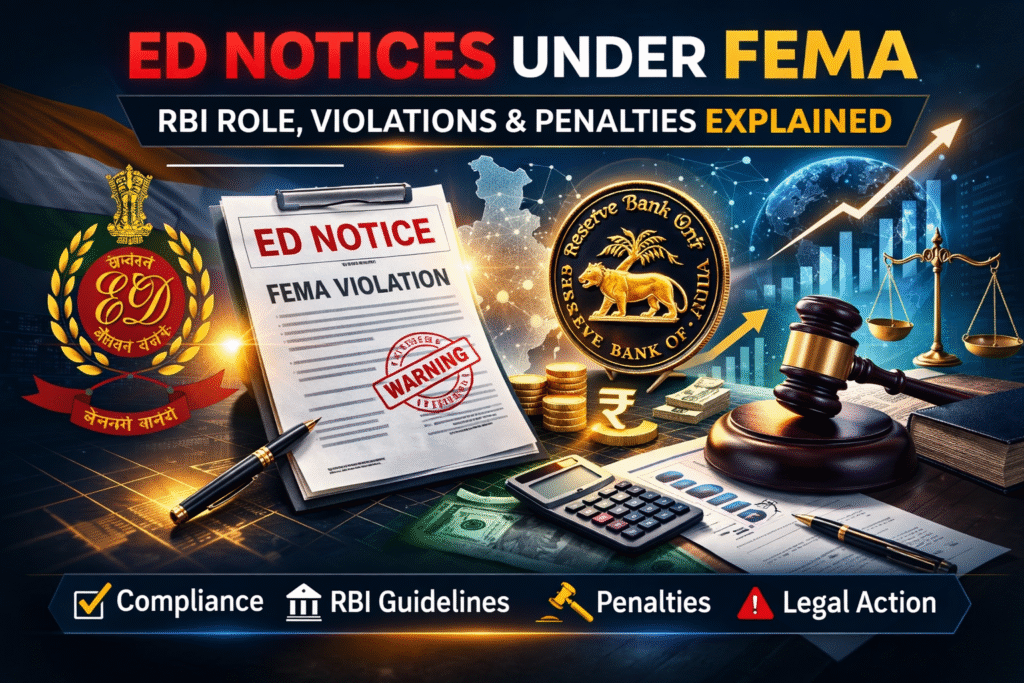
Foreign exchange compliance in India is no longer a routine procedural matter. In recent years, ED notices under FEMA have increased significantly due to tighter regulatory monitoring and data integration between banks, RBI, and enforcement agencies.
Indian businesses, NRIs, startups, and foreign investors engaging in cross-border transactions must understand how FEMA enforcement works — and how minor reporting lapses can escalate into serious regulatory exposure.
What Are ED Notices Under FEMA?
An ED notice under FEMA is issued by the Enforcement Directorate when there is prima facie evidence of a contravention of the Foreign Exchange Management Act, 1999.
Although FEMA is a civil law, violations can result in:
- Significant monetary penalties
- Adjudication proceedings
- Asset attachment
- Restrictions on future foreign exchange transactions
ED notices typically seek explanations, documentation, and justification for suspected non-compliance.
Why ED Issues Notices Under FEMA
ED does not initiate action randomly. Most cases arise from:
- Data shared by RBI
- Reporting gaps flagged by Authorized Dealer (AD) banks
- Income tax assessments
- Suspicious transaction reporting
- Audit findings
When material or repeated non-compliance is detected, the matter may escalate to ED investigation.
Common Violations That Trigger ED Notices Under FEMA
Businesses and individuals often face notices due to:
- Delayed or non-filing of FC-GPR / FC-TRS
- Improper routing of foreign investment
- Non-compliant share valuation or pricing
- Unauthorized guarantees to overseas entities
- External Commercial Borrowing (ECB) violations
- Retaining resident bank accounts after becoming NRI
- Incorrect remittance purpose codes
- Improper profit repatriation
- Structuring exits without FEMA planning
Even technical reporting delays can lead to regulatory scrutiny.
RBI vs ED Under FEMA: Understanding the Difference
FEMA enforcement involves two key authorities:
RBI – The Regulator
- Frames FEMA regulations
- Issues Master Directions and circulars
- Monitors cross-border transactions
- Grants approvals
- Handles compounding of contraventions
Enforcement Directorate (ED) – The Investigator
- Issues notices
- Conducts investigations
- Adjudicates violations
- Imposes penalties
Most FEMA matters originate at the RBI level and escalate to ED only when violations are serious, repeated, or wilful.
FEMA Compounding: RBI’s Corrective Mechanism
For procedural or reporting lapses, RBI offers compounding under FEMA.
Compounding allows:
- Voluntary admission of contravention
- Payment of monetary penalty
- Closure of matter without litigation
It is generally available for:
- Delayed filings
- Reporting errors
- Technical breaches
However, cases involving fund diversion, intentional violations, or large transaction values may proceed directly to ED.
Why FEMA Enforcement Has Increased
Several developments have intensified scrutiny:
- Digitised banking systems
- Real-time transaction reporting
- Integration of tax and FEMA databases
- Increased foreign investment inflows
- Stronger anti-money laundering frameworks
Regulators now identify inconsistencies faster than ever before.
Who Is Most at Risk of ED Notices Under FEMA?
- NRIs managing Indian bank accounts and investments
- Startups with foreign funding
- Companies receiving overseas loans
- Exporters and importers
- Foreign investors entering or exiting India
- Businesses restructuring cross-border holdings
Lack of awareness is not considered a valid defence under FEMA.
How to Avoid ED Notices Under FEMA
Preventive compliance is far more effective than post-violation defense.
Best practices include:
- Structuring investments correctly from inception
- Using only authorized banking channels
- Filing RBI reports within prescribed timelines
- Ensuring accurate valuation and pricing compliance
- Maintaining complete FEMA documentation
- Conducting periodic FEMA audits
- Seeking professional advisory before exits or restructuring
Strong compliance at the RBI level significantly reduces ED exposure.
Why Professional FEMA Advisory Is Critical
FEMA compliance involves more than form filing. It requires:
- Strategic transaction structuring
- Regulatory interpretation
- Risk assessment
- Bank coordination
- Representation before authorities
Expert advisory ensures regulatory alignment with business objectives while minimizing enforcement risk.
ED notices under FEMA reflect India’s increasingly structured foreign exchange ecosystem.
Businesses and individuals who approach FEMA compliance proactively operate with clarity and confidence. Those who treat it casually often face delays, penalties, and enforcement exposure later.
In cross-border transactions, compliance is not optional – it is foundational.
When facing ED notices under FEMA or responding to RBI scrutiny, precision matters.
Our team combines technical FEMA expertise with practical enforcement experience. We prepare structured responses, manage compounding applications, represent clients before authorities, and design defensible compliance strategies — helping businesses mitigate penalties and resolve foreign exchange exposures efficiently.