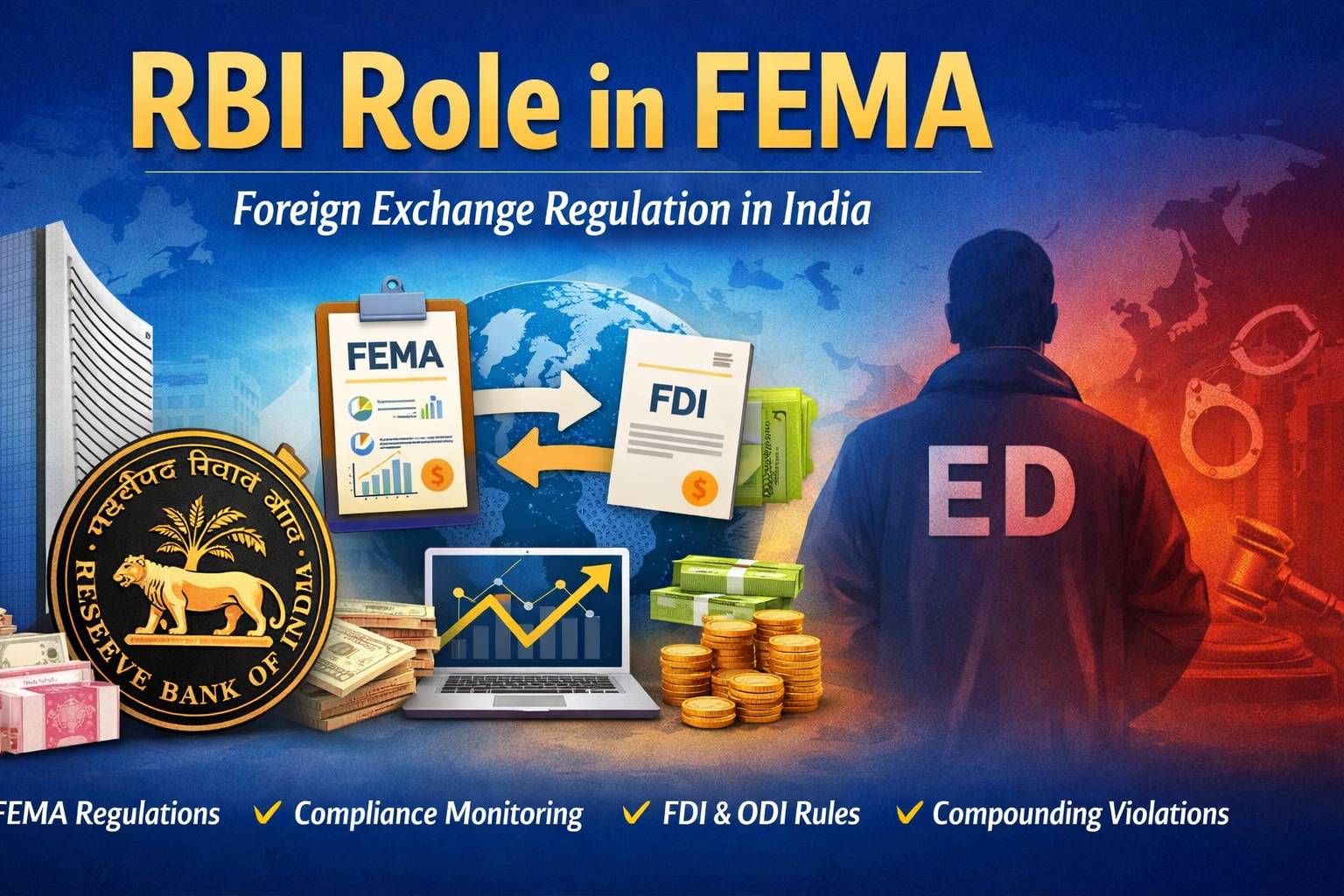
The Foreign Exchange Management Act (FEMA), 1999 is the backbone of India’s foreign exchange regulation framework. While enforcement actions often make headlines through the Enforcement Directorate, the Reserve Bank of India plays a far deeper and more continuous role in administering, regulating, and supervising FEMA compliance.
Understanding RBI’s role in FEMA is critical for NRIs, foreign investors, Indian companies, startups, and multinational corporations engaged in cross-border transactions.
What Is FEMA and Why RBI Matters
FEMA was enacted to facilitate external trade and payments, promote orderly development of India’s foreign exchange market, and regulate cross-border capital and current account transactions. Under FEMA, RBI regulates and monitors compliance, while ED investigates and penalises violations. RBI ensures compliance before and during transactions, whereas ED typically steps in after serious breaches occur.
RBI’s Statutory Authority Under FEMA
The RBI derives its authority directly from FEMA to frame regulations and directions, specify permissible and prohibited transactions, authorise banks and financial institutions, monitor foreign exchange flows, and regularise contraventions through compounding. Every foreign exchange transaction in India ultimately passes through an RBI-authorised channel.
Key Functions of RBI Under FEMA
Regulating Foreign Exchange Transactions
RBI determines which transactions are freely permitted, which require prior approval, and which are prohibited. This applies to Foreign Direct Investment (FDI), Overseas Direct Investment (ODI), External Commercial Borrowings (ECB), import–export payments, repatriation of funds, and guarantees or loans involving non-residents. Without RBI compliance, even a genuine transaction can become a FEMA contravention.
Issuing FEMA Regulations and Master Directions
RBI regularly issues FEMA Regulations, Master Directions, circulars, and clarifications that govern FDI policy and sectoral caps, pricing guidelines, ECB frameworks, Liberalised Remittance Scheme (LRS) transactions, NRI banking (NRE/NRO/FCNR accounts), and export–import compliance. Many violations arise due to lack of awareness of updated RBI guidelines rather than intentional wrongdoing.
Authorising Banks as Gatekeepers
RBI appoints Authorised Dealer (AD) Banks as the first line of FEMA compliance. These banks verify purpose codes, review documentation, report transactions to RBI, and flag suspicious or non-compliant flows. If a non-compliant transaction is processed, both the bank and the customer may face regulatory consequences. FEMA compliance begins before the transaction is executed, not after.
RBI Reporting and Compliance Monitoring
RBI mandates strict reporting timelines for forms and returns such as FC-GPR, FC-TRS, ECB returns, ODI filings, export realisation reports, and the Annual Return on Foreign Liabilities and Assets (FLA). Failure to report within prescribed timelines constitutes a technical violation under FEMA, even if the transaction itself was permissible.
Compounding of FEMA Contraventions
Compounding is one of RBI’s most important corrective mechanisms. It allows voluntary disclosure of violations, payment of a monetary penalty, and closure of the matter without prosecution. RBI typically handles compounding for reporting delays, procedural lapses, and inadvertent violations. Most FEMA matters involving individuals and corporates are resolved at the RBI level rather than through enforcement proceedings.
RBI vs ED: Understanding the Difference
RBI acts as the regulator and administrator with a preventive and corrective approach focused on compliance and reporting. The Enforcement Directorate functions as the investigative and enforcement authority with a punitive focus on serious violations. Many enforcement cases originate from RBI observations, bank compliance reports, or audit findings.
Common FEMA Issues Where RBI Is Involved
Common issues include failure to convert a resident account to NRO status after becoming an NRI, delayed FDI or ECB reporting, incorrect remittance purpose codes, non-compliant share pricing, unauthorized guarantees, improper repatriation of funds, and continued use of resident accounts after acquiring NRI status. In most situations, scrutiny begins at the RBI level.
Why RBI’s Role in FEMA Is Becoming More Critical
With increasing digitisation, automatic data sharing, strengthened banking controls, and global regulatory cooperation, RBI now monitors cross-border flows in near real time. PAN–Aadhaar–bank linkages and long-term transaction pattern analysis have made FEMA compliance system-driven rather than complaint-driven.
Why FEMA Compliance Must Start With RBI Strategy
Businesses and NRIs often focus only on avoiding enforcement notices. However, the correct strategy is to structure transactions according to RBI rules, ensure accurate and timely reporting, use authorised banking channels, and maintain proper documentation. Strong RBI-level compliance significantly reduces enforcement risk.
Final Thoughts
The Reserve Bank of India is not merely a regulator under FEMA but the architect of India’s foreign exchange ecosystem. Understanding its role helps prevent violations, avoid penalties, enable smooth investments and repatriation, and build long-term regulatory confidence. FEMA compliance is not about fear; it is about foresight.
Why Choose Us
Understanding RBI’s role under FEMA requires practical compliance expertise. We specialise in RBI filings, foreign investment structuring, downstream investment compliance, compounding applications, and regulatory advisory. Our team ensures transactions are structured correctly from the outset, reporting is timely and accurate, and regulatory risks are proactively managed. By combining strategic advisory with execution support, we help clients maintain long-term FEMA compliance with confidence.