Indian companies eyeing global acquisitions often hit a regulatory wall: the Foreign Exchange Management Act (FEMA), 1999. The Foreign Exchange Management (Overseas Investment) Rules, 2022 strictly prohibit Indian entities from remitting borrowed funds abroad for the purpose of acquiring foreign companies.
This means one of the most common strategies—taking an External Commercial Borrowing (ECB) and then routing it as Overseas Direct Investment (ODI)—becomes slow, approval-heavy, expensive, and often impractical.
ECB reporting, monthly compliance, and mandatory hedging requirements can delay acquisitions by months.
But here’s the good news:
There is a clean, 100% FEMA-compliant acquisition structure that top Indian corporates, PE-backed groups, and fast-scaling mid-sized companies are using in 2025.
And the route is fully legitimate from a FEMA, tax, and banking perspective.
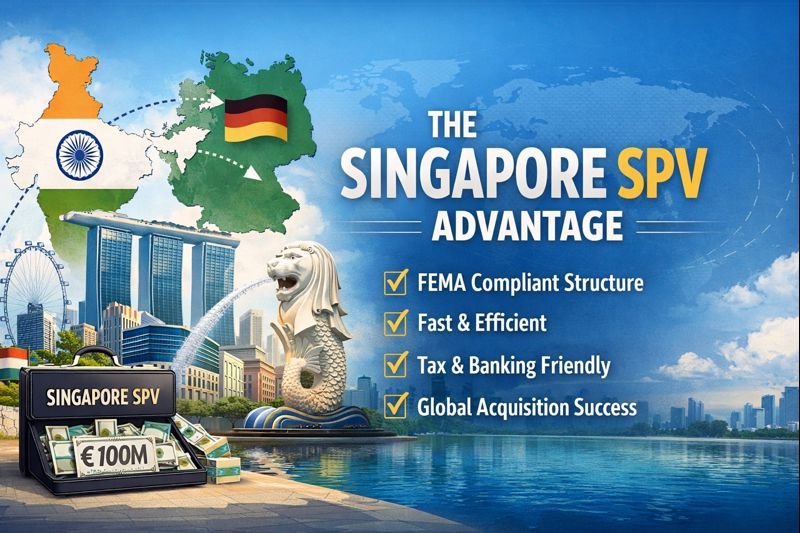
Case in Point: The Singapore SPV Advantage
ABC Private Limited — an Indian mid-sized manufacturer — identified a profitable German company being auctioned.
The bid size: €100 million.
The challenge?
Indian banks refused to remit borrowed funds abroad, as FEMA clearly prohibits overseas acquisition using domestic loans. ABC needed:
- Speed
- Leverage
- Regulatory compliance
- A globally acceptable acquisition vehicle
Enter the Singapore Special Purpose Vehicle (SPV) — one of the most preferred structures recommended by leading FEMA consultants, cross-border tax advisors, and M&A lawyers.
The Winning FEMA-Compliant Structure
1. Incorporate a Singapore Subsidiary (SPV)
ABC formed a wholly-owned subsidiary in Singapore — a process that takes 5–7 working days, with minimal regulatory friction.
2. ODI From India — Fully Under the Automatic Route
ABC remitted 75% of the bid amount (€75 million) from its own internal accruals under the Overseas Direct Investment (ODI) Automatic Route, fully permitted under FEMA (Overseas Investment) Rules, 2022.
No RBI approval.
No delays.
Full compliance.
3. The Remaining 25%? Funded in Singapore
The Singapore SPV approached DBS Bank (Singapore) and obtained the remaining €25 million as a loan.
This is perfectly legal because the foreign loan is taken outside India, by a foreign entity, and does not qualify as ECB.
This means:
- No ECB reporting
- No ECB compliance cycle
- No hedging requirement
- No RBI intervention
Global banks are comfortable lending to Singapore holding companies—especially when a strong Indian parent and a solid acquisition target are backing the transaction.
4. Successful Acquisition of the German Company
With the full €100 million available, the Singapore SPV completed the acquisition, beating competitors who were stuck in regulatory or financing delays.
5. Loan Servicing Through Global Cashflows
The German entity now pays dividends to the Singapore SPV.
The SPV uses these earnings to service the loan taken in Singapore.
No rupee funds leave India.
No FEMA violations.
Compliant. Clean. Efficient.
Result: Zero Violations, Maximum Efficiency
- Zero ECB paperwork
- Zero hedging cost on the foreign loan
- Bid closed in just 45 days
- Lower weighted cost of funds
- Fully FEMA compliant — no bank-borrowed Indian money sent abroad
This is exactly why large corporates partner with FEMA Advisors, FEMA consultants, and cross-border structuring experts before attempting overseas acquisitions.
Why This Structure Works (and Wins)
- Singapore is globally respected for tax clarity, treaty benefits, and ease of banking
- Foreign lenders prefer Singapore entities over Indian entities due to regulatory simplicity
- No conflict with ODI rules
- No conflict with ECB rules
- No breach of FEMA’s prohibition on “borrowed funds for overseas investment”
This model is being widely used by Indian promoters, family-owned conglomerates, and unicorns targeting European, US, and ASEAN acquisitions.
Key Takeaway
When it appears that FEMA blocks a transaction, the issue is rarely the law—it’s the structure.
A skilled FEMA consultant or experienced FEMA Advisory firm can design a route that is:
- Fully compliant
- Globally acceptable
- Faster to execute
- Cost-effective
- Regulator-friendly
Singapore, Mauritius, Netherlands, and Dubai remain the top jurisdictions for SPVs because of:
- Speed of incorporation
- Banking flexibility
- Double-taxation treaties
- Global lender comfort
- Predictable regulatory environments
In 2025–26, the Singapore SPV structure has become mainstream for Indian companies acquiring assets abroad — powerful, transparent, and 100% compliant.
Think Global. Structure Smart. Stay FEMA-Compliant.
If your organisation is planning overseas expansion, acquisitions, or group restructuring, working with the right FEMA Advisors can save you months of delays, avoid penalties, and ensure that every step remains within FEMA and ODI rules.